Bible Studies / Biblical Context & Questions
How the Biblical Day Worked: Sunset-to-Sunset Reckoning, the 12-Hour Day & Inclusive Counting
Why did the biblical day begin at sunset—and how do "three days" and "the third hour" actually work in Scripture?
Modern Western clocks flip the calendar date at midnight and measure duration with a 24-hour stopwatch. Biblical writers measured time by the sun: a new calendar day began at sunset, daylight was divided into twelve hours from sunrise, and any portion of a sunset-to-sunset calendar day counted as a whole day.
Published 2026-08-14 · Updated 2026-08-14 · 12 minute read
In Brief
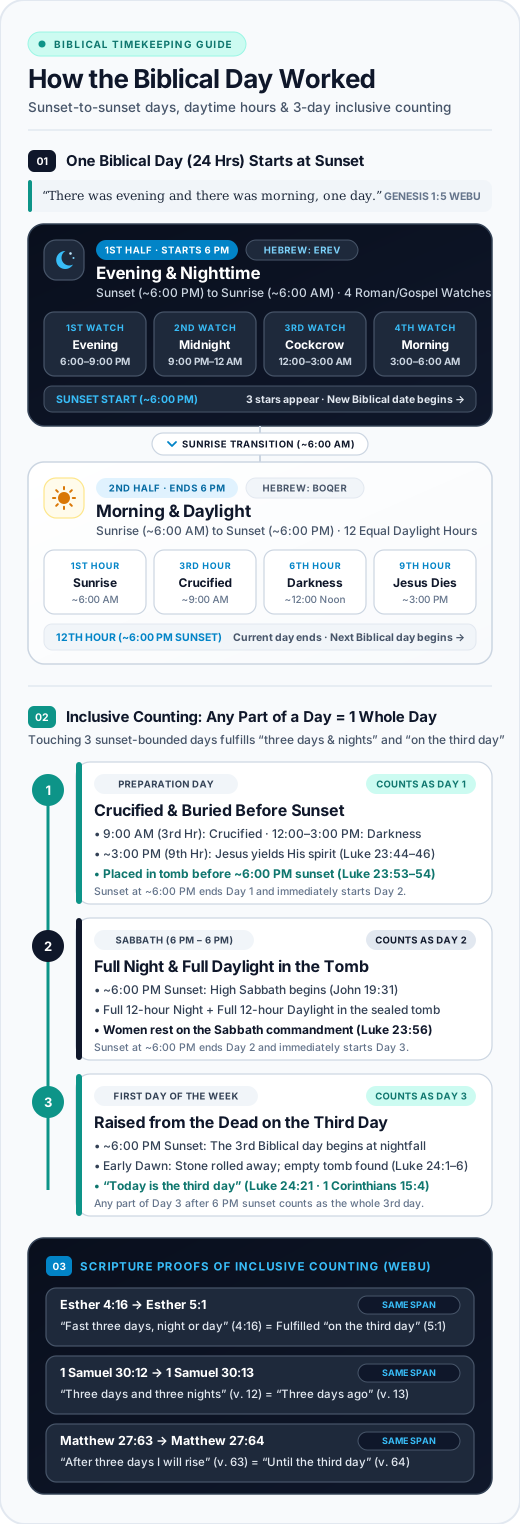
In Scripture, a calendar day begins at sunset ('there was evening and there was morning,' Genesis 1:5; Leviticus 23:32), while daylight is divided into twelve seasonal hours starting at sunrise (~6:00 AM). Furthermore, ancient Hebrew and Greco-Roman timekeeping used inclusive counting, where any part of a sunset-to-sunset calendar day counts as a whole day—making 'three days and three nights' and 'on the third day' synonymous expressions.
1. Why the Biblical Day Begins at Sunset ('Evening and Morning')
In the modern world, a new calendar date begins invisibly in the middle of the night at 12:00 AM. In the ancient biblical world, however, a new day began visibly when the sun dropped below the western horizon and the first evening stars appeared. That rhythm is established in the opening chapter of Scripture: 'God called the light Day, and the darkness he called Night. There was evening and there was morning, the first day' (Genesis 1:5 WEBU).
Notice the order repeated six times across the creation week: evening ('erev, עֶרֶב) comes first, followed by morning (boqer, בֹּקֶר). Night was not the leftover tail of the previous date; it was the opening half of the new calendar day. When the sun set at approximately 6:00 PM, the old calendar date ended and the next calendar date immediately began.
The Torah makes this sunset-to-sunset boundary explicit in Israel's festival and Sabbath legislation. Concerning the Day of Atonement, Leviticus 23:32 instructs Israel: 'from evening to evening, you shall keep your Sabbath.' Nehemiah enforced the same boundary in Jerusalem by commanding that the city gates be shut 'when it began to be dark before the Sabbath' (Nehemiah 13:19). And in the Gospels, crowds waited until sunset had passed before carrying the sick to Jesus so they would not violate the Sabbath rest: 'At evening, when the sun had set, they brought to him all who were sick' (Mark 1:32).
- A biblical calendar day (yom, יוֹם) runs from sunset (~6:00 PM) to the following sunset (~6:00 PM).
- Evening ('erev) opens the calendar day; morning (boqer) opens its daylight half.
- Sabbaths and feast days begin at sunset on the preceding evening and conclude at sunset the next day (Leviticus 23:32).
- Events occurring before and after sunset belong to two different calendar dates even if they are only minutes apart.
Sources: STEP Bible; NET Bible; TheTorah.com
2. The 12-Hour Daylight Clock & Night Watches
While the calendar date turned at sunset, daily work and public life were measured by the twelve hours of daylight between sunrise (~6:00 AM) and sunset (~6:00 PM). Jesus refers directly to this everyday reality in John 11:9: 'Aren’t there twelve hours of daylight? If a man walks in the day, he doesn’t stumble, because he sees the light of this world.'
Because these twelve hours were seasonal (proportional subdivisions of the actual daylight between dawn and dusk), the First Hour began at sunrise (~6:00 AM), and the Twelfth Hour ended at sunset (~6:00 PM). In Jesus' parable of the laborers in the vineyard (Matthew 20:1–12), the landowner hires workers early in the morning (~6:00 AM), then goes back out at the Third Hour (~9:00 AM), the Sixth Hour (~12:00 Noon), the Ninth Hour (~3:00 PM), and finally the Eleventh Hour (~5:00 PM, with only one hour of daylight left before sunset).
Nighttime, by contrast, was divided into military guard 'watches' rather than numbered hours. In the Old Testament, Israel divided the night into three four-hour watches: the beginning of the watches (Lamentations 2:19), the middle watch (Judges 7:19), and the morning watch (Exodus 14:24). By the New Testament period, Judea also used the four-watch Roman system, which Jesus names in Mark 13:35: 'whether at evening [6–9 PM], or at midnight [9 PM–12 AM], or when the rooster crows [12–3 AM], or in the morning [3–6 AM].'
Quick Reference: Converting Biblical Daytime Hours
Whenever you read a numbered hour in the Gospels or Acts, add six to the biblical hour to approximate the modern clock time:
- First Hour (Sunrise): ~6:00 AM — Daily temple morning preparations and the start of the workday (Matthew 20:1).
- Third Hour: ~9:00 AM — Morning temple prayer and sacrifice; the hour of Jesus' crucifixion in Mark 15:25 and the Pentecost outpouring in Acts 2:15.
- Sixth Hour: ~12:00 Noon — Midday when the sun is highest; Peter prays on the rooftop in Acts 10:9, and darkness falls over the land in Matthew 27:45.
- Ninth Hour: ~3:00 PM — The afternoon hour of prayer and evening temple sacrifice (Acts 3:1); Jesus cries 'It is finished' in Mark 15:34–37.
- Eleventh Hour: ~5:00 PM — Late afternoon, one hour before sunset (Matthew 20:6–9).
- Twelfth Hour (Sunset): ~6:00 PM — End of the daylight clock and the immediate start of the next calendar day.
Sources: NET Bible; United States Conference of Catholic Bishops
Sources: NET Bible; United States Conference of Catholic Bishops
3. What 'Between the Two Evenings' (Bein Ha'arbayim) Means
One of the most intriguing time phrases in the Old Testament is the Hebrew idiom bein ha'arbayim (בֵּין הָעַרְבָּיִם)—literally 'between the two evenings.' God commands Israel to sacrifice the Passover lamb 'at evening' (Hebrew: between the two evenings) on the fourteenth day of the first month (Exodus 12:6; Leviticus 23:5; Numbers 9:3), and the daily afternoon temple offering (the tamid) was likewise offered 'between the two evenings' (Exodus 29:39–41).
How could there be two evenings? In Second Temple Jewish practice, the first 'evening' began when the afternoon sun started its noticeable decline after midday (around the Ninth Hour, ~3:00 PM, when shadows lengthened), and the second 'evening' arrived when the sun actually set (~6:00 PM). The first-century Jewish historian Flavius Josephus—himself a Jerusalem priest—confirms that during the Second Temple era the Passover lambs were slain in the temple courts from the Ninth Hour until the Eleventh Hour (~3:00 PM to ~5:00 PM).
That historical detail illuminates the Passion narratives with remarkable precision. At the Ninth Hour (~3:00 PM)—the exact window 'between the two evenings' when the afternoon tamid and Passover sacrifices were offered in the temple—Jesus cried out with a loud voice and gave up his spirit (Matthew 27:46–50; Mark 15:34–37).
Sources: STEP Bible; University of Chicago; TheTorah.com
4. How Inclusive Counting Works in Hebrew & Ancient Near Eastern Thought
When modern English speakers say 'three days,' we often picture an elapsed stopwatch of 72 hours (3 × 24 hours). Ancient Hebrew, Aramaic, and Koine Greek speakers, however, normally counted calendar days inclusively. Under inclusive reckoning, you count the starting calendar day, every full calendar day in between, and the ending calendar day—even if only a fraction of the first and last calendar days is involved.
This occurs because the Hebrew word yom (יוֹם) and the Greek word hemera (ἡμέρα) can denote either the daylight portion of a day or the entire sunset-to-sunset calendar unit. Moreover, in Hebrew idiom, the compound phrase 'a day and a night' (or 'days and nights') was a fixed merism—a figure of speech naming the two halves ('evening and morning') to mean a calendar day (an onah in rabbinic terminology). Just as we say 'I worked three days on this project' without meaning 72 consecutive sleepless hours, ancient writers treated any touchpoint on a calendar date as counting for that day.
Later Jewish legal teaching preserved in the Jerusalem Talmud (Shabbat 9:3) and Babylonian Talmud (Pesachim 4a) summarized this ancient customary rule directly: 'A part of a day is like the whole of it' (miqtsat ha-yom ke-kullo), and any portion of an onah (a day-or-night period) counts as the whole calendar unit.
- Exclusive (Modern Stopwatch) Counting: Measures 72 elapsed hours from a specific timestamp.
- Inclusive (Biblical Calendar) Counting: Counts each distinct sunset-to-sunset calendar date touched by the event—Day 1 (even if only the final hours before sunset), Day 2 (full day), and Day 3 (even if early in the morning).
- Idiomatic Equivalence: Because 'a day and a night' was an idiom for a calendar day, 'after three days,' 'three days and three nights,' and 'on the third day' were used interchangeably by the same biblical authors.
Sources: NET Bible; New Advent
5. Old Testament Proofs of Inclusive Counting (Esther 4:16 & 5:1)
We do not have to guess whether biblical writers treated 'three days and three nights' as equivalent to 'on the third day'—Scripture itself demonstrates the equivalence side by side. The clearest example appears in the book of Esther. Facing Haman's decree, Queen Esther sends word to Mordecai in Esther 4:16 (WEBU): 'Go, gather together all the Jews who are present in Shushan, and fast for me, and neither eat nor drink three days, night or day. I and my maidens will also fast the same way. Then I will go in to the king, which is against the law; and if I perish, I perish.'
Notice Esther's exact words: 'neither eat nor drink three days, night or day'—and 'then I will go in to the king.' Yet two verses later, Esther 5:1 records when she went in: 'Now on the third day, Esther put on her royal clothing, and stood in the inner court of the king’s house.' She did not wait until a fourth day after 72 full hours had elapsed; in Hebrew narrative, a fast of 'three days, night or day' concludes 'on the third day'!
The exact same pattern recurs across the Old Testament. In Genesis 42:17, Joseph puts his brothers in custody 'for three days,' and Genesis 42:18 immediately says, 'Joseph said to them the third day, "Do this, and live."' In 1 Kings 20:29, Israel and Syria camp opposite each other 'seven days,' and 'on the seventh day the battle was joined.' In 2 Chronicles 10:5, Rehoboam tells the people, 'Come to me again after three days,' and verse 12 reports: 'So Jeroboam and all the people came to Rehoboam the third day, as the king bade, saying, "Come to me again the third day."'
Side-by-Side Biblical Parallels of Inclusive Counting
Compare how identical time spans are described first as a full count ('three days and nights' or 'after three days') and then fulfilled 'on the third day':
- Esther 4:16 vs. Esther 5:1 — 'fast for me... three days, night or day' → fulfilled 'on the third day, Esther put on her royal clothing.'
- Genesis 42:17 vs. Genesis 42:18 — 'he put them all together into custody for three days' → fulfilled 'Joseph said to them the third day.'
- 2 Chronicles 10:5 vs. 10:12 — 'Come to me again after three days' → fulfilled 'all the people came to Rehoboam the third day, as the king bade.'
- 1 Samuel 30:12 vs. 30:13 — An Egyptian servant had eaten nothing 'three days and three nights' → he explains to David, 'three days ago [literally: today is the third day] I fell sick.'
- Matthew 27:63 vs. Matthew 27:64 — The chief priests quote Jesus saying, 'After three days I will rise again,' and immediately ask Pilate to command the tomb to be made secure 'until the third day.'
Sources: NET Bible; STEP Bible
Sources: NET Bible; STEP Bible
6. Applying the Clock to the Crucifixixion, Burial & Resurrection
When we bring sunset-to-sunset calendar days, the twelve daytime hours, and inclusive counting together, the New Testament Passion and Resurrection accounts fit together with extraordinary clarity. In Matthew 12:40, Jesus invokes the sign of Jonah ('three days and three nights in the heart of the earth'), while in Matthew 16:21, 17:23, 20:19, Luke 24:46, and 1 Corinthians 15:4, Jesus and the apostles declare that he rose 'on the third day.'
Walk through the three sunset-to-sunset calendar days recorded in the four Gospels:
Day 1 (Preparation Day, paraskeue — Nissan 14): Jesus is crucified at the Third Hour (~9:00 AM, Mark 15:25), darkness covers the land from the Sixth Hour (~12:00 Noon) to the Ninth Hour (~3:00 PM, Matthew 27:45), and Jesus dies at the Ninth Hour (~3:00 PM, Mark 15:34–37). Because the Sabbath will begin at sunset (~6:00 PM) and the bodies must not remain on the cross into the High Sabbath (John 19:31), Joseph of Arimathea and Nicodemus urgently wrap Jesus' body and lay him in the tomb before sunset: 'It was the Preparation Day, and the Sabbath was drawing near' (Luke 23:54). The moment Jesus is laid in the tomb before Friday's ~6:00 PM sunset, Day 1 of inclusive burial is counted.
Day 2 (The Sabbath — Nissan 15): At sunset (~6:00 PM Friday), a new calendar day begins. The women rest 'on the Sabbath, according to the commandment' (Luke 23:56), and the tomb remains sealed through the night and the daylight hours until Saturday sunset (~6:00 PM). That full sunset-to-sunset span is Day 2.
Day 3 (The First Day of the Week — Nissan 16): At sunset on Saturday (~6:00 PM), the third calendar day ('the first day of the week') begins! Sometime between Saturday sunset and Sunday dawn, Jesus rises bodily from the dead. When the women arrive at the tomb 'on the first day of the week, at early dawn' (Luke 24:1; John 20:1), the stone is already rolled away and the angels announce: 'He isn’t here, but is risen! Remember what he told you when he was still in Galilee, saying that the Son of Man must be delivered up into the hands of sinful men, and be crucified, and the third day rise again?' (Luke 24:6–7). Later that same Sunday afternoon, the Emmaus disciples confirm to the risen Lord: 'today is the third day since these things happened' (Luke 24:21).
- Day 1 (Preparation Day): ~3:00 PM death & burial before ~6:00 PM Friday sunset → counts as Calendar Day 1.
- Day 2 (Sabbath Rest): ~6:00 PM Friday sunset to ~6:00 PM Saturday sunset → counts as Calendar Day 2.
- Day 3 (First Day of the Week): ~6:00 PM Saturday sunset through Sunday dawn (~6:00 AM) → counts as Calendar Day 3 ('on the third day').
Sources: NET Bible; NET Bible; United States Conference of Catholic Bishops
7. Resolving 'The Sixth Hour' in John 19:14 vs. 'The Third Hour' in Mark 15:25
Careful readers often notice one more timekeeping question in the Passion narratives: Mark 15:25 states, 'It was the third hour, and they crucified him,' whereas John 19:14 says of Pilate's final judgment seat before the crucifixion, 'Now it was the Preparation Day of the Passover, at about the sixth hour.' How do these two notes relate?
Biblical scholars point out two complementary historical factors. First, ancient timekeeping without mechanical clocks was approximate ('about the sixth hour,' hosai hekte), dividing the morning into broad quadrants centered on the third hour (~9:00 AM) and sixth hour (~12:00 Noon). Mark's 'third hour' marks the conclusion of the morning trial/scourging phase and the start of the crucifixion process, while Matthew, Mark, and Luke all agree that by the 'sixth hour' (~12:00 Noon) Jesus was on the cross as darkness fell over the land (Matthew 27:45; Mark 15:33; Luke 23:44).
Second, some historians note that Roman legal and civil officials (and writers addressing Greco-Roman audiences in Asia Minor, where John wrote) also reckoned official civil hours from midnight rather than sunrise—under which 'about the sixth hour' in Pilate's Praetorium would be ~6:00 AM, leaving the hours between 6:00 AM and 9:00 AM for the scourging, the soldiers' mockery, the carrying of the cross through Jerusalem, and the nailing to the cross at the third hour (~9:00 AM). Under either explanation, both Evangelists are describing the same morning sequence leading up to midday darkness at noon and Jesus' death at 3:00 PM.
8. How to Read Biblical Time References with Confidence
Once you step inside the biblical clock, passages that once seemed puzzling become cohesive eyewitness markers. The biblical authors were not writing with modern digital wristwatches or midnight calendar transitions; they were writing within the lived rhythm of sunset-to-sunset days, sunrise-to-sunset hours, and inclusive calendar counting.
Whenever you encounter a time marker in your daily Bible reading, keep three simple questions in view: (1) Did a sunset occur between these two events, shifting the calendar day? (2) Is the writer naming a daytime hour counted from ~6:00 AM sunrise? (3) Is a multi-day span being counted inclusively across calendar dates? Holding those three historical lenses together lets you read both Testaments on their own terms—and see how faithfully God's Word fits together.
- Remember the Sunset Boundary: Friday 4:30 PM and Friday 7:00 PM are two different calendar days in the Bible.
- Add 6 to Biblical Hours: The 3rd hour is ~9 AM, the 6th hour is ~12 Noon, and the 9th hour is ~3 PM.
- Count Calendar Days Inclusively: Touching any part of Day 1, Day 2, and Day 3 fulfills both 'three days and three nights' and 'on the third day.'
Frequently asked questions about the biblical day and three-day counting
- Why does the Jewish day start at sunset instead of midnight?
In Genesis 1:5, each day of creation is summarized with the refrain, 'There was evening and there was morning, the first day.' Because evening ('erev) is named first and morning (boqer) second, Israel reckoned each new calendar day as beginning at sunset (~6:00 PM) and lasting until the following sunset (Leviticus 23:32).
- What is inclusive counting in the Bible?
Inclusive counting is the ancient Hebrew, Greek, and Roman practice of counting any portion of a calendar day as a whole day in a multi-day sequence. If an event begins before sunset on Day 1, continues through Day 2, and concludes after sunrise on Day 3, it spans three calendar days and is described both as 'three days' and as ending 'on the third day.'
- How can 'three days and three nights' (Matthew 12:40) equal 'on the third day' (Luke 24:46)?
In Hebrew idiom, 'a day and a night' was a figure of speech (merism) for a calendar day, even when only part of that day was involved. Esther 4:16 and 5:1 prove this directly: Esther commands a fast for 'three days, night or day' (4:16) and then goes in to the king 'on the third day' (5:1). Likewise, in Matthew 27:63–64, the chief priests equate Jesus' prediction 'After three days I will rise' with securing the tomb 'until the third day.'
- What time of day are the 3rd, 6th, and 9th hours in the New Testament?
New Testament daytime hours were counted across the twelve hours of daylight starting at sunrise (~6:00 AM). Therefore, the Third Hour is ~9:00 AM (Mark 15:25; Acts 2:15), the Sixth Hour is ~12:00 Noon (Matthew 27:45; Acts 10:9), the Ninth Hour is ~3:00 PM (Mark 15:34; Acts 3:1), and the Eleventh Hour is ~5:00 PM (Matthew 20:6).
- What does 'between the two evenings' mean in Exodus 12:6?
The Hebrew phrase bein ha'arbayim ('between the two evenings') refers to the afternoon transition between the sun's decline after midday (~3:00 PM, the first evening) and sunset (~6:00 PM, the second evening). The first-century Jewish priest and historian Josephus records that the Passover lambs were sacrificed in the temple between the ninth and eleventh hours (~3:00–5:00 PM)—the exact window when Jesus died on the cross at the ninth hour.
- Why did Jesus have to be buried before sunset on Preparation Day?
Because the Sabbath began at sunset (~6:00 PM), and Deuteronomy 21:22–23 required that a body not remain hanging overnight (cf. John 19:31; Luke 23:54). By burying Jesus before sunset on Preparation Day, his burial touched Calendar Day 1 before the sunset transition into the Sabbath (Calendar Day 2).
Study key passages on biblical timekeeping
- Genesis 1:5–8 — Evening and Morning: The Creation Day Rhythm
See how Genesis 1 establishes the evening-first ('erev and boqer) boundary of the biblical calendar day.
- Exodus 12:5–8 — The Passover Lamb 'Between the Two Evenings'
Explore the Passover twilight instruction (bein ha'arbayim) and how it points forward to the Ninth Hour.
- Leviticus 23:30–34 — From Evening to Evening Shall You Keep Your Sabbath
Study the explicit Torah statute defining sacred festival days from sunset to sunset.
- Esther 4:12–17 — Three Days, Night or Day: Esther's Fast
Examine the Old Testament key to Hebrew inclusive counting before Esther approaches the king.
- Esther 5:1–5 — On the Third Day Esther Stood Before the King
See how the 'three days, night or day' fast of Esther 4:16 is fulfilled 'on the third day' in Esther 5:1.
- Matthew 12:36–40 — The Sign of Jonah and Three Days in the Earth
Understand Jesus' prophecy of three days and three nights in light of Hebrew inclusive timekeeping.
- Matthew 20:1–5 — Workers at the Third, Sixth, Ninth, and Eleventh Hours
Walk through the 12-hour daylight clock in Jesus' parable of the laborers in the vineyard.
- Mark 15:25–28 — Crucified at the Third Hour (~9:00 AM)
Trace the morning hours of the crucifixion in Mark's Passion timeline.
- Mark 15:29–33 — Darkness from the Sixth Hour to the Ninth Hour
Study the midday darkness (~12:00 Noon to ~3:00 PM) preceding Jesus' final cry.
- Luke 23:54–56 — Preparation Day and the Approaching Sabbath Sunset
See how Joseph of Arimathea and the women honor the sunset Sabbath boundary on Day 1 and Day 2.
- Luke 24:1–4 — Early Dawn on the First Day of the Week
Explore the empty tomb discovery on Calendar Day 3 and the angels' reminder of 'the third day.'
- 1 Corinthians 15:1–10 — Raised on the Third Day According to the Scriptures
Study the earliest apostolic creed of Christ's death, burial, and third-day resurrection.
Related Bible chapters
- Genesis 1 — The creation week refrain: 'There was evening and there was morning.'
- Exodus 12 — The institution of the Passover sacrifice on Nissan 14.
- Leviticus 23 — The appointed feasts of the LORD and evening-to-evening Sabbath reckoning.
- Esther 4 — Esther's three-day fast before approaching King Ahasuerus on the third day.
- Mark 15 — The Third Hour, Sixth Hour, Ninth Hour, and Preparation Day evening burial.
- Luke 24 — The resurrection on the third day and the road to Emmaus ('today is the third day').
Sources and editorial method
This guide was prepared with AI assistance using the listed biblical, primary, and academic sources. All Scripture quotations and passage links follow the World English Bible Updated (WEBU), and the guide does not claim a named human theological reviewer.
- STEP Bible: Genesis 1:5 Hebrew Lexicon ('erev and boqer) — STEP Bible
- NET Bible Translation & Textual Notes on Leviticus 23:32 — NET Bible
- STEP Bible: Exodus 12:6 Hebrew Notes (bein ha'arbayim) — STEP Bible
- Flavius Josephus, Against Apion & Jewish Antiquities Primary Text Archive — University of Chicago
- STEP Bible: Esther 4:16–5:1 Hebrew Text & Inclusive Idiom — STEP Bible
- NET Bible Notes on Matthew 12:40 (Three Days and Three Nights Idiom) — NET Bible
- NET Bible Notes on Mark 15:25, 33, 42 (Biblical Hours & Preparation Day) — NET Bible
- NET Bible Notes on John 19:14 (The Sixth Hour on Preparation Day) — NET Bible
- Matthew 20 Text & Notes on Daytime Hours — United States Conference of Catholic Bishops
- Luke 23–24 Text & Notes on Preparation Day, Sabbath, and the Third Day — United States Conference of Catholic Bishops
- Biblical Calendar and Sacred Time in the Torah — TheTorah.com
- Biblical Chronology and Ancient Reckoning of Days and Hours — New Advent