
Joshua 1:9
“Haven’t I commanded you? Be strong and courageous. Don’t be afraid. Don’t be dismayed, for the LORD your God is with you wherever you go.”
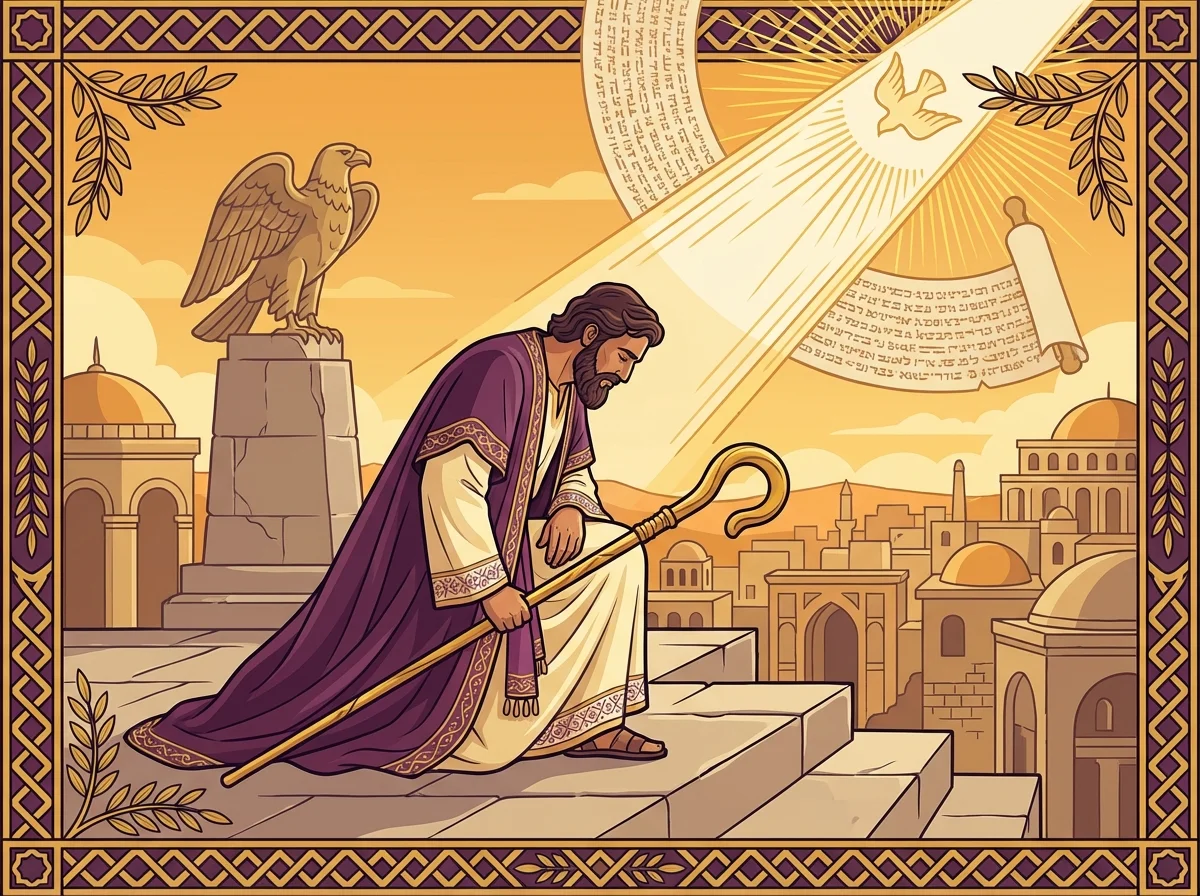
Joshua 1:9 – The Command to Courage in the Face of the Unknown
The Hook
We all eventually stand on the banks of our own "Jordan River"—a boundary line between the familiar past and an uncertain, overwhelming future. Whether it is assuming a new leadership role, navigating a frightening medical diagnosis, or stepping out in faith after a season of loss, the transition can feel paralyzing. Joshua 1:9 is not merely a pep talk for the timid; it is a divine recalibration of reality, reminding us that the antidote to fear is not self-confidence, but the assured presence of the Almighty God.
Setting: The narrative of Joshua 1 takes place on the plains of Moab, just east of the Jordan River. The timing is critical—it is the end of the forty-year wilderness wandering (approx. 1406 BC). The Israelites are camped within sight of the Promised Land, but a formidable natural barrier (the river at flood stage) and military barriers (fortified cities like Jericho) stand in their way. This is a liminal space: the space between promise and fulfillment.
Cultural Background: To understand the weight of this verse, we must understand the concept of succession in the Ancient Near East. In the ancient world, the death of a king or charismatic leader was a moment of supreme vulnerability. Nations were often invaded or fell into civil war during transitions of power.
Furthermore, Moses was not just a leader; he was the mediator of the Covenant, the man who spoke to God face-to-face. For Joshua to step into Moses' sandals was an impossibly high calling. The "shadow of the giant" was vast. The Israelites were a stiff-necked people who had rebelled against Moses repeatedly. Joshua had every sociological and military reason to be terrified.
Original Audience: These words were spoken directly by Yahweh to Joshua, the son of Nun, but they serve a dual purpose for the nation of Israel. The original audience was the "second generation"—those who had grown up in the wilderness after their parents died due to unbelief. This generation needed to know that the God of Sinai was not just the God of their parents, but their God too. They needed assurance that the Covenant presence did not die on Mount Nebo with Moses.
Deep Dive Analysis
Key Words Study
To fully grasp the richness of God's command, we must examine the Hebrew vocabulary used in this charge.
-
Chazaq (חָזַק) - Transliteration: khaw-zak’
- Meaning: To fasten upon, to seize, to be strong, to grow firm.
- Pastoral Insight: This word often refers to physical strength or the strength of one's hand. In the context of battle or leadership, it implies a tensile strength—the ability to hold on tight and not let go. It is an external fortitude. God is calling Joshua to a firmness of hand and purpose.
-
Amats (אָמַץ) - Transliteration: aw-mats’
- Meaning: To be stout, strong, bold, alert.
- Pastoral Insight: While chazaq often leans toward physical firmness, amats leans toward mental and spiritual fortitude. It is the strength of the mind and the will. It implies an obstinacy against surrender. Together, chazaq and amats cover the totality of human resilience: physical action and inner resolve.
-
Arats (עָרַץ) - Transliteration: aw-rats’
- Meaning: To tremble, to dread, to be terrified, to break.
- Pastoral Insight: This is a visceral word. It means to be broken or shattered by a sudden alarm. It is the feeling of panic that causes one to freeze. God is not forbidding the emotion of fear (which is often involuntary), but the state of being shattered or paralyzed by it.
-
Chathath (חָתַת) - Transliteration: khaw-thath’
- Meaning: To be dismayed, shattered, cracked, or abolished.
- Pastoral Insight: Translated as "dismayed" in the WEB, this word conveys confusion and discouragement. It creates an image of someone looking around in bewilderment, having lost their bearings. It is the loss of hope.
Walk Through It Verse by Verse
"Haven’t I commanded you?" The verse opens with a rhetorical question that functions as an assertion of authority. In Hebrew, this phrasing grounds the subsequent command in the relationship between Master and servant. God is cutting off Joshua’s exit strategy. This is not a suggestion, a wish, or a piece of advice; it is a divine mandate. If God commands it, He provides the resources to fulfill it. The question implies, "Remember who is speaking. The burden of the outcome rests on the Commander, not the soldier."
"Be strong and courageous." This is the third time in this chapter (v. 6, v. 7, v. 9) that God repeats this phrase. Repetition in Hebrew literature signifies emphasis and urgency. God acknowledges implicitly that Joshua feels weak and timid. If Joshua naturally felt brave, the command would be unnecessary. Courage is not the absence of fear; it is obedience in the presence of fear. God calls for a deliberate act of the will (amats) to move forward despite the trembling.
"Don’t be afraid. Don’t be dismayed," Here, God addresses the internal emotional landscape of the leader. To "be afraid" focuses on the object of terror (the giants, the fortified walls). To "be dismayed" focuses on the internal reaction (confusion, hopelessness). God is forbidding Joshua from fixating on the "what ifs." He is commanding Joshua to guard his heart against the paralyzing effects of anxiety. It is a prohibition against looking at the waves instead of the One who controls the sea.
"for the LORD your God is with you wherever you go." This is the ground clause—the theological foundation that makes the command possible. In logic, this is the premise that supports the conclusion.
- Why can I be strong? Not because I am skilled. Not because the army is big.
- Reason: Because Yahweh is there.
The name used here is "Yahweh Elohim"—the Covenant Lord and the Creator God. The One who made the universe and swore an oath to Abraham is personally accompanying Joshua. This promise of presence changes the equation of every battle. One plus God is always a majority.
life-giving Significance
Key Themes
-
The Immanuel Principle (God With Us) The central theological pillar of Joshua 1:9 is that Divine Presence is the prerequisite for Divine Mission. We see this pattern throughout Scripture: God calls a person to an impossible task (Moses, Gideon, Jeremiah, Mary), the person expresses fear or inadequacy, and God’s counter-argument is never, "You are stronger than you think." God’s counter-argument is always, "I will be with you." Joshua 1:9 teaches us that our confidence is strictly theological, not psychological. We are courageous because He is present.
-
The Continuity of God’s Work This passage emphasizes that while God’s workmen are buried, His work continues. Moses was the greatest prophet in Israel's history, yet his death did not pause God's plan. This teaches the sovereignty of God over human history. God transfers the mantle of leadership to show that the power never resided in Moses’ personality, but in God’s calling. The God of the wilderness is also the God of the conquest. He is immutable (unchanging) amidst human transitions.
Gospel Connection
Joshua 1:9 is a shadow that points directly to the substance of Jesus Christ.
- The Name: The name "Joshua" (Hebrew: Yehoshua) means "Yahweh is Salvation." The Greek equivalent is Iesous—Jesus. Joshua is a "type" of Christ. Where Joshua led the people into an earthly rest (Canaan), Jesus leads us into the ultimate eternal rest (Hebrews 4:8-10).
- The Command Fulfillment: Jesus is the ultimate fulfillment of the strong and courageous servant. In the Garden of Gethsemane, facing a terror far greater than the giants of Canaan—the wrath of God against sin—Jesus did not turn back. He was "strong and courageous" to the point of death, securing our salvation.
- The Great Commission: The promise of Joshua 1:9 ("I is with you wherever you go") is echoed almost verbatim by Jesus in the Great Commission in Matthew 28:20: "Behold, I am with you always, even to the end of the age." As believers, we have the Spirit of the Greater Joshua living inside us, empowering us for our mission.
Reflection Questions
- Introspective: When you look at the "territory" in front of you (your future, your responsibilities), where do you feel most "dismayed" or shattered? Be honest about where you feel the urge to retreat.
- Relational: Joshua needed to be strong not just for himself, but so he could lead others into the promise. Who in your life (family, small group, coworkers) is currently relying on your courage? How does your anxiety or courage affect them?
- Action-Oriented: If you truly believed—without a shadow of a doubt—that the Creator of the Universe was walking into your workplace or home with you tomorrow, how would your posture, tone of voice, or decision-making change?
This Week's Challenge
"Name the Giant, Claim the Promise"
- Identify one specific area where fear is causing you to procrastinate or avoid a decision (The Giant).
- Write it down on a card.
- Beneath it, write: "Have I not commanded you? The Lord is with me in this."
- Take one specific, measurable step toward confronting that fear this week (e.g., make the phone call, send the email, have the difficult conversation). Do it not because you feel brave, but as an act of obedience to the command.
Prayer
Father, I confess that I often look at the giants in my land and feel small. I am easily dismayed by the unknown and paralyzed by the possibility of failure. Thank You that my strength does not come from my own resources, but from Your abiding presence. Lord Jesus, You are the Greater Joshua who has already conquered the ultimate enemies of Sin and Death. Because You are with me, I choose today to be strong and courageous. I will step forward in faith, believing that You are already in the future I fear. In Jesus’ name, Amen.