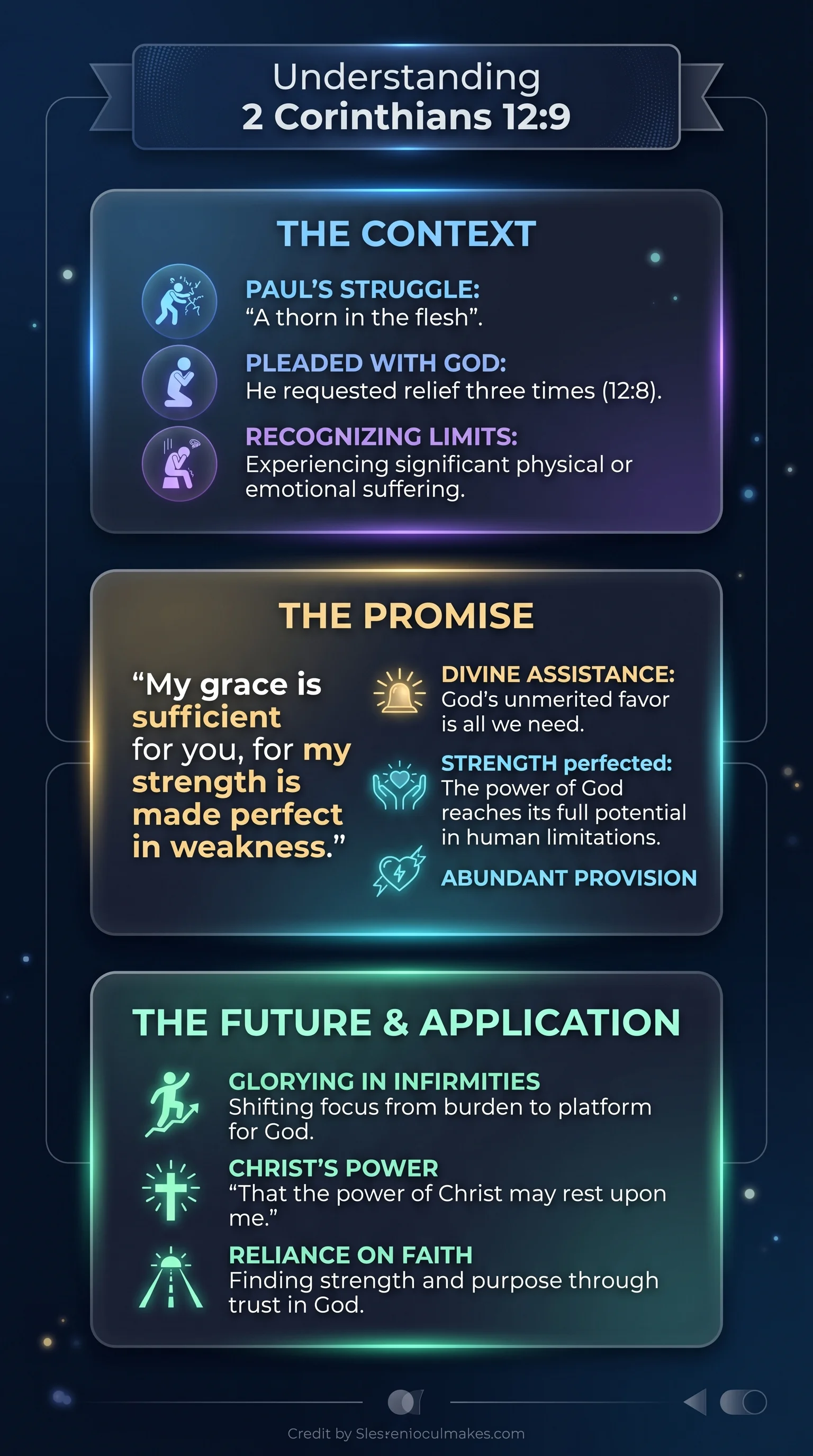
2 Corinthians 12:9
“He has said to me, “My grace is sufficient for you, for my power is made perfect in weakness.” Most gladly therefore I will rather glory in my weaknesses, that the power of Christ may rest on me.”

2 Corinthians 12:9 — Perfect Power in Our Weakness
📖 The Verse
⁹ He has said to me, “My grace is sufficient for you, for my power is made perfect in weakness.” Most gladly therefore I will rather glory in my weaknesses, that the power of Christ may rest on me.
When you reach the absolute end of your own strength, God does not abandon you; instead, He meets you in your brokenness, transforming your deepest vulnerabilities into the very stage where His limitlessly sufficient grace displays its greatest power.
To understand the explosive nature of this verse, we must step into the bustling, status-obsessed city of ancient Corinth around AD 55. Rebuilt by Julius Caesar as a Roman colony, Corinth was a wealthy commercial hub filled with upwardly mobile merchants, philosophers, and athletes. In this highly competitive culture, personal strength, wealth, and eloquent public speaking were the ultimate measures of human worth. Boasting about one's achievements and high social standing was not just accepted; it was the primary currency of social advancement. Into this environment stepped the Apostle Paul, whose physical presence was unimpressive and whose speech was deemed contemptible by local standards (2 Corinthians 10:10). After Paul left Corinth, charismatic false teachers—whom Paul sarcastically labels "super-apostles"—moved in and began undermining his authority (2 Corinthians 11:5). These critics mocked Paul’s physical ailments, his history of imprisonment, and his manual labor, claiming that his constant sufferings proved he was not a true messenger of God. To survive this ministerial crisis, Paul had to write a deeply personal, raw, and defensive letter to vindicate his apostolic calling. Instead of matching his opponents' flashy credentials, Paul turns their worldly values completely upside down in chapters 10 through 12. He defends his authority not by bragging about his successes, but by boasting of his shipwrecks, beatings, and humiliations (2 Corinthians 11:23-28). He reluctantly reveals that he was granted breathtaking visions of heaven, but notes that God immediately balanced this privilege by giving him a painful limitation (2 Corinthians 12:1-7). He calls this persistent physical or emotional affliction a "thorn in the flesh" and a "messenger of Satan" designed to keep him humble. Paul begged the Lord three times to remove this agonizing thorn, expecting a miracle of deliverance (2 Corinthians 12:8). Instead of removing the pain, Jesus answers Paul directly with the revolutionary words of 2 Corinthians 12:9. This divine response completely redefined Christian suffering, showing that God's power is not displayed by escaping human limitations, but by shining through them.
🔍 Original Language Deep Dive
The Original Text: εἴρηκέν μοι· Ἀρκεῖ σοι ἡ χάρις μου· ἡ γὰρ δύναμις ἐν ἀσθενείᾳ τελεῖται. Ἥδιστα οὖν μᾶλλον καυχήσομαι ἐν ταῖς ἀσθενείαις μου, ἵνα ἐπισκηνώσῃ ἐπ’ ἐμὲ ἡ δύναμις τοῦ Χριστοῦ. (eirēken moi: Arkei soi hē charis mou; hē gar dynamis en astheneia teleitai. Hēdista oun mallon kauchēsomai en tais astheneiais mou, hina episkenōsē ep' eme hē dynamis tou Christou.) The Greek structure reveals a dynamic tension between human helplessness and divine fullness. The verbs are carefully conjugated to show that Christ’s answer is a permanent, ongoing reality for every believer facing an ongoing struggle. Key Word Breakdown:
- ἀρκεῖ (arkei) — This is the present active indicative of the verb arkeō, which means "to be enough," "to suffice," or "to possess unfailing strength." Because it is written in the present tense, it denotes an ongoing, constant, and ceaseless state of being entirely sufficient for every single micro-moment of our lives. It means Christ's grace is not a limited reserve tank that we risk running dry, but an overflowing, self-replenishing well of divine favor that meets us precisely where we are.
- χάρις (charis) — This is the Greek word for "grace," representing the unmerited, active, and transforming favor of God toward helpless humanity. In this context, it is not merely a passive theological concept or an attitude of kindness, but God's personal, dynamic energy invading human weakness to accomplish what we could never do on our own. It is the supernatural fuel that sustains us when our natural resources are completely depleted.
- δύναμις (dynamis) — This refers to "power," "inherent ability," or "miraculous strength," from which we derive the English word dynamite. In the New Testament, it represents the resurrection power of God that overcomes death, sin, and decay (Romans 1:16). Here, Christ explains that this explosive divine power is not diluted by our weakness, but is actually brought to its full, visible expression when we have nothing left to offer.
- τελεῖται (teleitai) — This is the present passive of teleō, meaning "to bring to completion," "to perfect," "to finish," or "to fully accomplish." It does not mean God's power somehow becomes stronger when we are weak, but rather that His power is fully realized, visible, and consummated in our empty vessels. When we are strong in ourselves, we obscure His glory; when we are weak, His power is displayed in its purest, unclouded form.
- ἐπισκηνώσῃ (episkenōsē) — This rare and beautiful word literally means "to pitch a tent over," "to tabernacle," or "to spread a shelter over." It directly echoes the Old Testament concept of the Shekinah glory of God dwelling in the Tabernacle among His people in the wilderness (Exodus 40:34-35). Paul is rejoicing because his weaknesses are the exact pegs upon which Christ pitches the glorious tent of His protective, dwelling presence.
🔥 Life-Giving Significance
This passage sits at the very heart of New Testament theology, illustrating the "upside-down" nature of the Kingdom of God. It reveals that God's redemptive plan does not bypass human suffering and limitation, but actively works through them to destroy human pride and magnify His sovereign grace (Ephesians 2:8-9). This radically reframes the history of the world; though sin introduced weakness, decay, and death into the world through the Fall (Genesis 3:19), God in His infinite wisdom uses these very limitations as raw materials for His modern-day creative restoration. Furthermore, this passage provides a stunning revelation of Christ's character and His ongoing, intimate relationship with His suffering Church. Jesus does not speak to Paul from a distant, unapproachable heaven, but speaks with the tender authority of the Great High Priest who is intimately acquainted with our griefs (Hebrews 4:15). By declaring "My grace is sufficient," Jesus presents Himself as the all-sufficient Savior whose finished work on the cross satisfies every spiritual and physical bankruptcy we will ever experience (Colossians 2:9-10). The Holy Spirit works through our physical and emotional limitations to crucify our self-reliance, ensuring that our faith rests not in human wisdom, but in the power of God (1 Corinthians 2:5). In terms of covenant promises, this verse reassures us that our union with Christ guarantees His protective presence over our lives. When Paul prays for the thorn to be removed, Christ offers him something infinitely better: His abiding presence, described through the imagery of the Tabernacle (episkenōsē). This highlights the progression of salvation history, showing how the God who once dwelt in a physical temple made of stone now chooses to dwell within and spread His sheltering glory over fragile, clay-pot human lives (2 Corinthians 4:7). Thus, our weaknesses are not obstacles to God’s plan, but are the divine invitations for His covenant faithfulness and power to be put on public display. Ultimately, this truth flows directly from the work of Jesus Christ on the cross. The cross was the ultimate historical display of strength masked in apparent weakness, where the Savior of the world conquered sin and death through submission and physical brokenness (Colossians 2:14-15). When we embrace our own weaknesses, we are participating in this cruciform pattern of life, showing the world that our ultimate hope lies not in our temporary earthly strength, but in the eternal, resurrection power of Jesus.
✨ Key Insights
- Sufficiency in the Present Tense: The Greek verb for "is" in "My grace is sufficient" denotes an ongoing, unending reality that never lapses or expires. Christ does not promise future grace for hypothetical scenarios, but assures us that His grace is actively and perfectly sufficient for this exact micro-moment of pain.
- Power Requires an Empty Vessel: God’s perfect power does not co-exist with human self-sufficiency; it demands that we reach the absolute end of our own capability. When we empty ourselves of pride and the illusion of control, we create the necessary spiritual vacuum for Christ’s strength to flood in and take over.
- The Glory of Boasting in Scars: Paul flips the world’s value system on its head by bragging about his limitations rather than hiding them. In a culture obsessed with curated perfection, the believer's greatest witness is often not their highlight reel, but how they endure suffering with supernatural joy.
- A Shift from Cure to Endurance: Sometimes God’s greatest mercy is not removing our thorn, but sustaining us through it. The preservation of the believer in the midst of the burning bush of suffering is a far greater miracle than the immediate extinguishing of the flames.
- The Tabernacle of Christ's Presence: The word for "rest on me" (episkenōsē) reveals that our pain is the canvas where Christ pitches His tent. Your weaknesses are not signs of God's abandonment, but are the structural supports where His sheltering glory chooses to rest.
- Weakness as a Spiritual Guardrail: The thorn was given to Paul to keep him from becoming conceited due to his heavenly revelations. Our limitations are often God's loving, protective boundaries designed to keep us close to Him and prevent us from falling into the trap of self-exaltation.
📚 Cross-Reference Treasury
-
2 Corinthians 4:7 (WEBU)
"But we have this treasure in clay vessels, that the exceeding greatness of the power may be of God, and not from ourselves."
This passage expands on the theme of human fragility acting as a vessel for divine power, showing that our weaknesses exist precisely to highlight God's unmatched glory.
-
Philippians 4:13 (WEBU)
"I can do all things through Christ who strengthens me."
This famous verse reveals the practical outcome of sufficient grace, demonstrating that our endurance and victory in every circumstance come entirely from Christ infusing us with His strength.
-
Isaiah 40:29 (WEBU)
"He gives power to the weak; and to those who have no might he increases strength."
This Old Testament promise echoes Christ's words to Paul, confirming that God's character has always been to bestow supernatural energy specifically upon those who recognize their complete lack of strength.
-
Hebrews 4:16 (WEBU)
"Let’s therefore draw near with boldness to the throne of grace, that we may receive mercy, and may find grace for help in time of need."
This verse connects to the availability of Christ's sufficient grace, inviting us to confidently approach Him in our weakest moments to find the timely help He promises.
-
Psalm 73:26 (WEBU)
"My flesh and my heart fails, but God is the strength of my heart and my portion forever."
This Old Testament cry perfectly prefigures Paul's testimony, showcasing that even when our physical and emotional capacities completely give out, God remains our ultimate, unshakable source of strength.
🌍 A Picture of This Truth
Imagine a young woman named Sarah who inherited a priceless, antique ceramic bowl from her beloved grandmother. This bowl was her most treasured possession, representing family history, deep love, and security. One afternoon, it slipped from her hands and shattered into dozens of jagged pieces on the kitchen floor. Devastated by the loss, she gathered the broken fragments and brought them to a master craftsman who specialized in the ancient art of kintsugi—the practice of repairing broken pottery with a special lacquer dusted with pure, powdered gold. Sarah expected him to try and hide the cracks, to glue them together so seamlessly that no one would ever know it had been broken. Instead, the master craftsman explained that his goal was not to disguise the damage, but to illuminate it. He painstakingly rejoined the fractured edges using the brilliant, shining gold adhesive, tracing every jagged line, crack, and break with glowing metallic light. When he finished, the bowl was not only structurally stronger than it had been before, but it was also infinitely more beautiful, with the gold-veined cracks catching the light and telling a stunning story of restoration. The scars of the vessel did not diminish its value; rather, the gold made the brokenness the most precious and captivating part of the entire piece. Anyone looking at the bowl would no longer focus on the fragility of the clay, but would stand in awe of the master’s golden work that held it all together. The cracks, which once represented ruin and uselessness, had become the very channels through which the artist’s beautiful, valuable gold was displayed to the world. That is exactly what Christ is saying in 2 Corinthians 12:9 when He tells us that His power is made perfect in our weakness. He does not wipe away our scars or hide our limitations; instead, He pours His golden, sufficient grace directly into our broken spaces, making our fragility the very place where His glorious strength is most beautifully revealed.
- Stop Hiding Your Thorns on Social Media: In an era of curated perfection and digital filters, practice vulnerability by being honest about your limitations with a trusted community, allowing others to see Christ’s strength in your real life.
- Shift Your Prayers from "Remove" to "Sustain": When facing a chronic difficulty or stressful situation, try changing your prayer focus from "Lord, take this away" to "Lord, let Your grace be sufficient for me in this very hour."
- Reposition Your Weakness as an Asset for Ministry: Instead of waiting until you have "everything together" to serve others, step out in your current weakness, trusting that God will use your limitations to comfort someone else experiencing the same pain (2 Corinthians 1:3-4).
- Audit Your Self-Reliance Habits: Identify one area of your life—whether in your parenting, career, or finances—where you are trying to operate in your own strength, and intentionally surrender that pressure to Christ through daily prayer.
- Celebrate Your Boundaries and Say No with Joy: Recognize that your physical and emotional limitations are not failures, but God-given boundaries designed to keep you resting under the shelter of His grace rather than burning out.
🙏 Reflection & Prayer
Reflect on this: What would it look like if you stopped viewing your deepest weakness as a spiritual failure, and instead saw it as the exact location where Christ's resurrection power wants to set up its home? A Prayer for Today:
Lord Jesus, I come to You today carrying the heavy weight of my own limitations, feeling exhausted by the constant pressure to be strong, perfect, and self-sufficient. I confess that I have often complained about my thorns, begging You to remove them while failing to see how they keep me close to Your heart. Today, I surrender my weaknesses, my anxieties, and my broken pieces into Your hands, trusting that Your grace is completely sufficient for me right now. Pitch the tent of Your glorious power over my fragile life, so that my limitations might become a showcase for Your strength. Fill my empty vessel with the power of Your Holy Spirit, and teach me to rest in the beauty of Your finished work on the cross. In Your holy and precious name, I pray. Amen.
💬 Share this deep dive with someone who needs it today — and come back tomorrow for the next Verse of the Day!