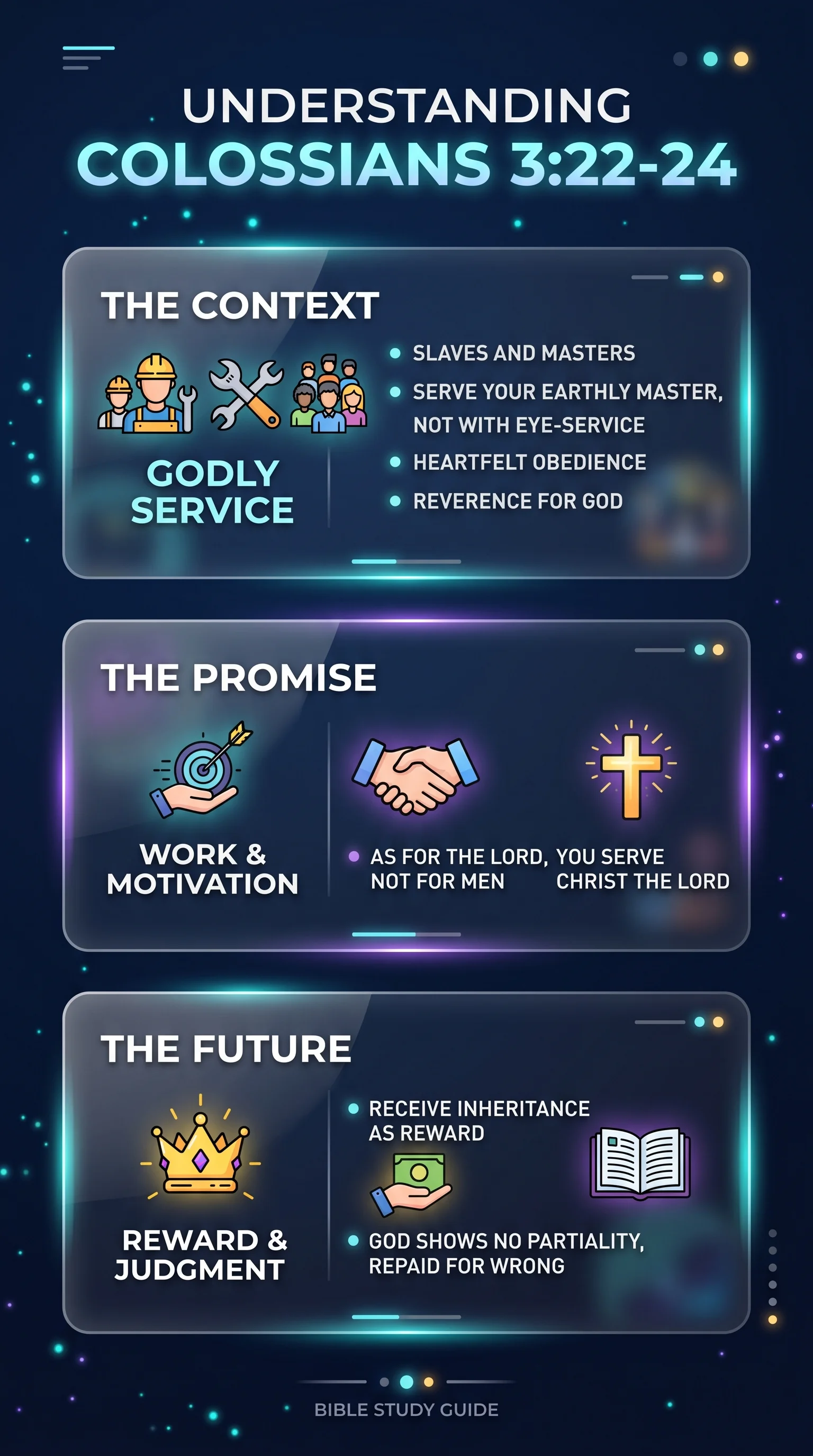
Colossians 3:22-24
“Servants, obey in all things those who are your masters according to the flesh, not just when they are looking, as men pleasers, but in singleness of heart, fearing God. And whatever you do, work heartily, as for the Lord and not for men, knowing that from the Lord you will receive the reward of the inheritance; for you serve the Lord Christ.”

Colossians 3:22-24 — Working for an Audience of One
📖 The Verse
²² Servants, obey in all things those who are your masters according to the flesh, not just when they are looking, as men pleasers, but in singleness of heart, fearing God. ²³ And whatever you do, work heartily, as for the Lord and not for men, ²⁴ knowing that from the Lord you will receive the reward of the inheritance; for you serve the Lord Christ.
When you realize your daily grind is actually a platform for holy worship, every mundane task becomes a direct transaction with the King of kings.
The Apostle Paul wrote this profound letter around AD 60–62 while bound in chains under house arrest in Rome (Acts 28:16, 30). Despite his physical confinement, his spirit remained fiercely free, prompting him to write to the young church in Colossae—a city in modern-day Turkey. He sought to combat a dangerous, syncretic heresy that threatened to undermine the supremacy of Jesus Christ by mixing pagan mysticism with Jewish legalism. The literary style of Colossians is an ancient Hellenistic epistle, characterized by warm greetings, deep doctrinal instruction, and direct, practical exhortations. In this specific section of the letter, Paul enters into what ancient scholars call a Haustafel, or a household code, which outlines relationships within the Roman home. This was not a theoretical lecture; it was a radical blueprint for how the Kingdom of God subverts and redeems the everyday structures of ancient Roman society. In the first-century Roman Empire, slavery was a massive, foundational institution, with some estimates suggesting that up to one-third of the population lived in servitude. These individuals had virtually no legal rights, often treated as mere living tools rather than human beings made in the image of God (Genesis 1:27). Paul does not write to endorse this brutal system, but to inject the explosive, transforming power of the Gospel directly into the lives of those trapped within it, completely redefining their worth and purpose. Archaeological excavations in Asia Minor reveal that Colossae was a bustling trade hub, known for its unique, dark red wool called colossinus. Within this commercial environment, Christian slaves and masters suddenly found themselves sitting side-by-side as equal brothers and sisters at the Lord's Table (Colossians 3:11). By addressing servants first and at the greatest length, Paul bestows immense dignity upon the most marginalized members of society, reminding them that their daily labor is viewed by God as sacred service.
🔍 Original Language Deep Dive
The Original Text: ὑπακούετε κατὰ πάντα τοῖς κατὰ σάρκα κυρίοις, μὴ ἐν ὀφθαλμοδουλίαις ὡς ἀνθρωπάρεσκοι, ἀλλ’ ἐν ἁπλότητι καρδίας φοβούμενοι τὸν Κύριον. ὃ ἐὰν ποιῆτε, ἐκ ψυχῆς ἐργάζεσθε, ὡς τῷ Κυρίῳ καὶ οὐκ ἀνθρώποις, εἰδότες ὅτι ἀπὸ Κυρίου ἀπολήμψεσθε τὴν ἀνταπόδοσιν τῆς κληρονομίας. τῷ Κυρίῳ Χριστῷ δουλεύετε. (hypakouete kata panta tois kata sarka kyriois, mē en ophthalmodouliais hōs anthrōpareskoi, all' en haplotēti kardias phoboumenoi ton Kyrion. ho ean poiēte, ek psychēs ergazesthe, hōs tō Kyriō kai ouk anthrōpois, eidotes hoti apo Kyriou apolēmpsesthe tēn antapodosin tēs klēronomias. tō Kyriō Christō douleuete.) In these three verses, Paul utilizes precise, highly active Greek verbs and vivid compound nouns to shift the believer’s perspective from earthly, temporal labor to an eternal, heavenly calling. His choice of words completely redefines the master-servant dynamic by placing the Lord Jesus Christ at the center of every physical transaction. Key Word Breakdown:
- ἀνθρωπάρεσκοι (anthrōpareskoi) — This compound word combines anthrōpos (human) and areskō (to please), literally translating to "men-pleasers." It describes someone who only works hard when they are being watched, performing purely for human applause and temporary approval. Paul warns against this performative trap, urging believers to seek the steady, loving gaze of God rather than the fickle, temporary approval of human eyes (Galatians 1:10).
- ἁπλότητι (haplotēti) — Translated as "singleness" or "sincerity" of heart, this Greek word carries the rich agricultural meaning of a crop free from weeds, or a metal that is unalloyed and pure. It denotes a life free from duplicity, double-mindedness, or hidden motives. In spiritual terms, it means having an undivided heart that is completely focused on honoring God alone, without any secret side-hustles of self-glorification or bitterness (James 1:8).
- ἐκ ψυχῆς (ek psychēs) — Literally meaning "out of the soul" or "from the very life-force," this phrase is translated as "heartily" or "wholeheartedly." It means putting your entire being, your emotions, your intellect, and your physical strength into the task at hand. Paul uses this to show that work is not just a physical activity, but a spiritual expression of our love for God, demanding our best efforts regardless of who our boss is (Deuteronomy 6:5).
- ἀνταπόδοσιν (antapodosin) — This powerful word refers to a full, complete, and reciprocal payback or recompense. It is not a small tip or a basic wage, but a grand, divine settlement that perfectly balances the scales of justice. For the ancient slave who had no legal right to own property or receive wages, this promise of a heavenly "payback" from God Himself was a revolutionary and liberating assurance (Luke 14:14).
- δουλεύετε (douleuete) — Rooted in the word for a bondservant, this verb means "to serve as a slave" or "to yield obedience to." In the Greek sentence structure, it acts as a stunning climax: "for you serve the Lord Christ." Paul uses this word to dramatically shift our focus, revealing that no matter who signs our earthly paycheck, our true Employer, Master, and Owner is Jesus Christ Himself (Romans 1:1).
🔥 Life-Giving Significance
To fully grasp the theological weight of Colossians 3:22-24, we must trace the narrative arc of labor from the very beginning of Scripture. In Genesis 2:15, God placed man in the Garden of Eden to cultivate and keep it, demonstrating that work is not a curse, but a beautiful, pre-Fall creation design meant to reflect God's own creative and sustaining character. However, the Fall introduced sin, frustration, and thorns into our labor, twisting work from a joyful act of worship into a grueling source of identity, idolatry, and oppression (Genesis 3:17-19). Work became a battleground of greed, exploitation, and soul-crushing exhaustion, as seen in the brutal systems of human history. Jesus Christ entered this broken world to redeem every square inch of human existence, including our everyday labor. Through His perfect life as a carpenter's son (Mark 6:3) and His sacrificial death on the cross, Christ broke the power of sin and bought us back from our slavery to self and fear (Ephesians 1:7). He did not just save our souls for eternity; He redeemed our daily work in the present. By taking on the form of a servant Himself (Philippians 2:7), Christ sanctified the ordinary, making the lowest tasks a theater of divine glory. Now, when a believer works, they do not labor to earn God's love or establish their own worth; they work out of the secure, overflowing reality of being fully loved, redeemed, and adopted into God's family (Romans 8:15). This passage also points forward to the ultimate Restoration, where our work will be completely liberated from the effects of the Fall. The Holy Spirit empowers us today as a down payment of this future hope, transforming our hearts so that we can work with supernatural joy, integrity, and patience in difficult environments (Ephesians 5:18-21). The "reward of the inheritance" mentioned in verse 24 reminds us that our labor in the Lord is never in vain; it has eternal weight (1 Corinthians 15:58). In the New Heavens and the New Earth, we will continue to work, build, and create for the glory of God, but without the weariness, frustration, or injustice of the present age (Isaiah 65:21-23). Colossians 3:22-24 thus stands as a bridge, transforming our temporary, daily secular tasks into eternal, spiritual investments.
✨ Key Insights
- The Elevation of Ordinary Labor: God does not divide our lives into the "sacred" and the "secular," but claims every spreadsheet, sink of dirty dishes, and business meeting as an altar of true worship (1 Corinthians 10:31).
- The Trap of Eye-Service: Working hard only when the boss is watching reveals a heart that worships human approval rather than the living God, reducing our character to a mere performance (Proverbs 29:25).
- The Ultimate Equalizer: By addressing slaves as direct servants of the Lord Christ, the Gospel completely bypasses earthly hierarchies and gives supreme dignity to the most overlooked and undervalued workers (Galatians 3:28).
- The True Paymaster: No matter how ungrateful, demanding, or unfair our earthly supervisors might be, our ultimate reward comes from the generous hands of the Lord Jesus, who never forgets our labor of love (Hebrews 6:10).
- Singleness of Devotion: A divided heart leads to burnout and bitterness, but a heart anchored in the fear and love of God finds deep rest and focus, even in the midst of chaotic work environments (Matthew 6:24).
- Inheritance Over Wages: While earthly systems trade labor for temporary wages, God offers His children an eternal inheritance that can never perish, spoil, or fade, transforming how we view security (1 Peter 1:4).
📚 Cross-Reference Treasury
-
Ephesians 6:5-8 (WEBU)
"⁵ Servants, be obedient to those who according to the flesh are your masters, with fear and trembling, in singleness of your heart, as to Christ; ⁶ not in the way of eye-service, as men-pleasers, but as servants of Christ, doing the will of God from the heart; ⁷ with good will doing service, as to the Lord, and not to men; ⁸ knowing that whatever good thing each one does, he will receive this back from the Lord, whether he is bound or free."
Paul highlights the exact same principle to the Ephesian church, showing that doing our daily work "from the heart" is a universal Christian standard. It reinforces that our ultimate accountability is to Christ, who promises to repay every good deed we perform.
-
1 Corinthians 15:58 (WEBU)
"⁵⁸ Therefore, my beloved brothers, be steadfast, immovable, always abounding in the Lord’s work, because you know that your labor is not in vain in the Lord."
This passage connects our daily, physical efforts with the grand reality of Christ's resurrection. Because Jesus conquered the grave, every ounce of our labor done for His sake has eternal, permanent value.
-
Ecclesiastes 9:10a (WEBU)
"¹⁰ Whatever your hand finds to do, do it with your might; for there is no work, nor device, nor knowledge, nor wisdom, in Sheol, where you are going."
The wise teacher of Ecclesiastes reminds us of the urgency and value of applying ourselves wholeheartedly to our current earthly assignments. It echoes Paul's call to work "heartily" using the strength and opportunities God has provided.
-
Romans 12:11 (WEBU)
"¹¹ not lagging in diligence; fervent in spirit; serving the Lord;"
Paul urges the Roman believers to maintain a passionate, burning spiritual fervor while carrying out their practical responsibilities. Diligence in our daily tasks is presented as a direct reflection of our spiritual warmth and service to God.
-
Matthew 25:21 (WEBU)
"²¹ His lord said to him, 'Well done, good and faithful servant. You have been faithful over a few things. I will set you over many things. Enter into the joy of your lord.'"
Jesus' parable of the talents illustrates the grand "reward of the inheritance" that Paul promises to the Colossians. It shows that God does not measure success by the worldly scale of our task, but by the level of our faithfulness in completing it.
🌍 A Picture of This Truth
Every night at 11:00 PM, while the rest of the city slept, Arthur walked into the sterile, quiet hallways of the municipal hospital. Armed with a mop, a bucket of disinfectant, and a cart of fresh linens, his job was to clean the operating rooms after the surgeons had finished their long shifts. It was exhausting, messy, and entirely invisible work; no patient ever woke up to thank the man who sanitized the floor they walked on, and the administrators rarely noticed him unless a spot was missed. To many, it would seem like a dead-end, monotonous grind designed to wear down a person's soul. Yet, if you watched Arthur work, you would see something entirely different. He didn't just mop; he buffed the floors until they shone like mirrors. He didn't just wipe down tables; he meticulously disinfected every high-touch surface with the precision of a scientist. When a young resident doctor asked him why he worked with such intense dedication for minimum wage, Arthur smiled warmly and replied, "I don't just clean floors, Doctor. I help save lives by fighting infection. And more than that, I do this for the One who washed my soul clean." Arthur understood a secret that many high-powered executives spend their entire lives trying to learn. He knew that the value of his work was not determined by the size of his paycheck, the prestige of his title, or the praise of his supervisor. He realized that every stroke of his mop was an act of worship, a quiet prayer offered directly to the Creator of the universe. He was not working for the hospital board; he was working for the Lord of glory, and that changed everything. The difference in Arthur's attitude was not rooted in self-motivation or toxic positivity, but in a profound shift of allegiance. When you know that the King of kings is watching your work with a smile of approval, the most ordinary, repetitive chore is instantly infused with divine purpose. It rescues us from the soul-crushing need to please human bosses who might never appreciate us, and anchors us in the joyful security of a Father who sees every hidden act of faithfulness. That's exactly what Paul is saying in Colossians 3:22-24, where he calls us to work with undivided hearts, not to please human eyes, but because we are ultimately serving the Lord Christ. When we shift our focus from our earthly bosses to our heavenly Master, our daily grind is transformed into a sanctuary of praise. As the Scripture says: "And whatever you do, work heartily, as for the Lord and not for men, knowing that from the Lord you will receive the reward of the inheritance; for you serve the Lord Christ" (Colossians 3:23-24).
- Audit Your Motives Under the "Invisible" Test: Pay close attention to how your work ethic changes when your boss, client, or spouse is not looking. Challenge yourself to perform every task today with the same excellence, honesty, and care as if your supervisor were standing right next to you, remembering that God's loving eye is always upon you.
- Reframe Your "Have-To's" into "Get-To's" for Christ: When faced with a mundane or frustrating task today—whether it is responding to angry emails, folding piles of laundry, or compiling complex data sheets—pause and pray: "Lord Jesus, I offer this specific task directly to You as an act of worship." Watch how this simple mental and spiritual shift replaces resentment with quiet, holy joy.
- Release the Need for Human Applause: If you are feeling bitter because your hard work at your job, in your home, or in your ministry has gone completely unnoticed, consciously lay that hurt at the feet of Jesus. Remind yourself that your ultimate identity and reward are securely held by Him, and His "well done" is worth infinitely more than any earthly promotion or human praise.
- Cultivate Singleness of Heart in a World of Distraction: In our hyper-connected 2026 culture, it is easy to work with a divided mind—scrolling social media, checking notifications, or planning your next step while performing your current duties. Commit to bringing your full, undivided attention to your current task, honoring God by giving your best to the present moment.
- Practice Integrity in the Smallest Details: Whether it is filling out your timesheet with absolute accuracy, using company resources honestly, or speaking kindly about your difficult boss behind their back, let your daily choices reflect the holy fear of God. Your quiet integrity is a powerful, silent sermon that points a watching world to the transforming power of Jesus Christ.
🙏 Reflection & Prayer
Reflect on this: Where are you currently seeking the approval of "masters according to the flesh" at the expense of your joy, peace, and faithfulness to the Lord? What would it look like if you handed your entire daily to-do list over to Jesus Christ every morning, treating Him as your primary Boss and ultimate Paymaster? A Prayer for Today:
Heavenly Father, I come before You today acknowledging that my heart is so easily pulled toward seeking human approval and praise. Forgive me for the times I have allowed my daily work to become a source of anxiety, pride, or bitter resentment. Today, I surrender my career, my daily tasks, my chores, and my relationships into Your hands, declaring that You are my true Master. Teach me to work with a single-focused, undivided heart, putting my entire soul into everything I do as a love-offering to You. When I feel overlooked or unappreciated, remind me of the beautiful inheritance that is waiting for me in Christ. Help me to shine Your light in my workplace, serving others with the same humility and grace that Jesus showed to me. In the precious and holy name of the Lord Jesus Christ, I pray. Amen.
💬 Share this deep dive with someone who needs it today — and come back tomorrow for the next Verse of the Day!