
Hebrews 12:1-2
“Therefore let’s also, seeing we are surrounded by so great a cloud of witnesses, lay aside every weight and the sin which so easily entangles us, and let’s run with perseverance the race that is set before us, looking to Jesus, the author and perfecter of faith, who for the joy that was set before him endured the cross, despising its shame, and has sat down at the right hand of the throne of God.”
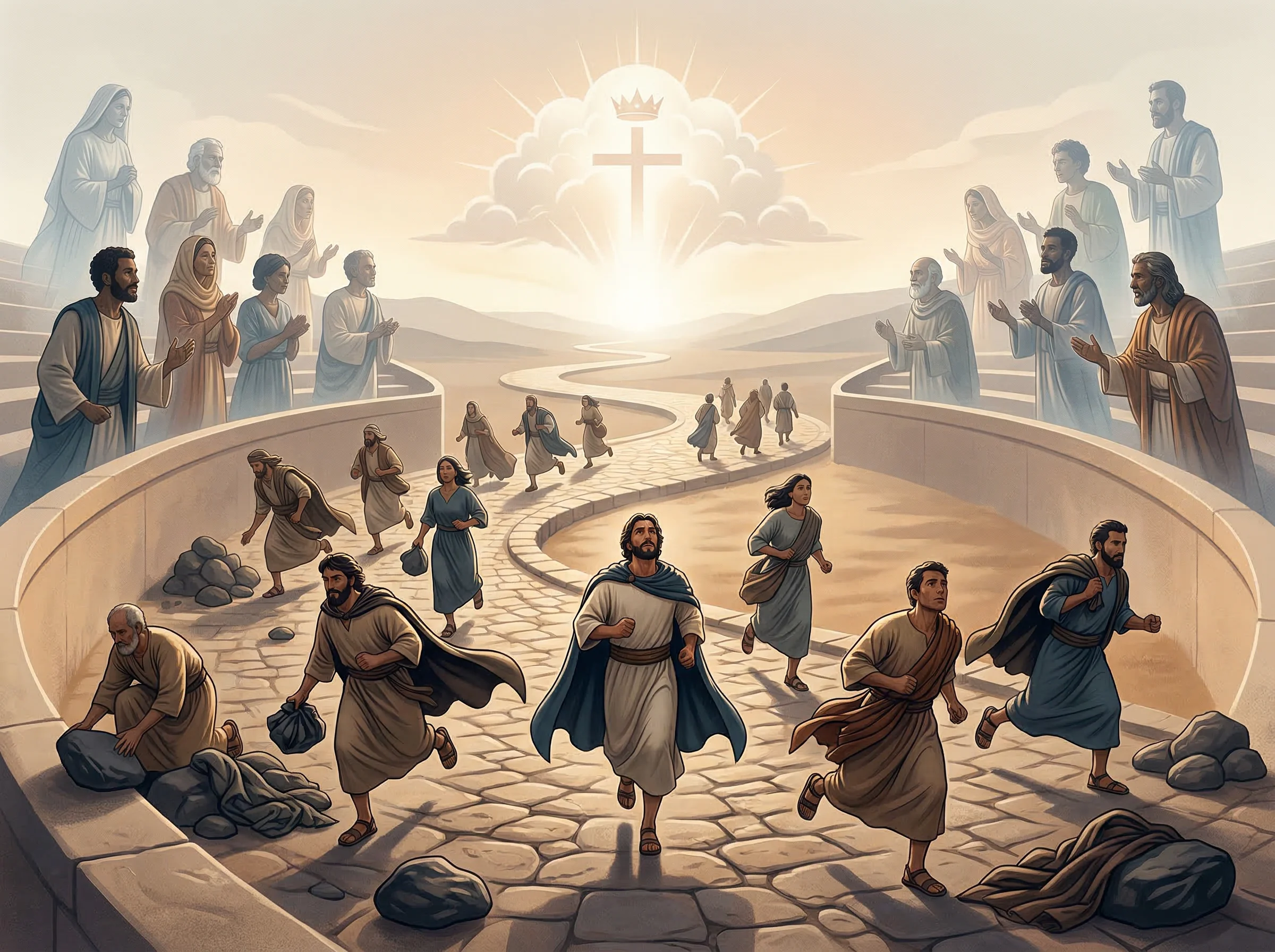
Hebrews 12:1-2 — Run Your Race Unburdened
📖 The Verse
¹ Therefore let’s also, seeing we are surrounded by so great a cloud of witnesses, lay aside every weight and the sin which so easily entangles us, and let’s run with perseverance the race that is set before us, ² looking to Jesus, the author and perfecter of faith, who for the joy that was set before him endured the cross, despising its shame, and has sat down at the right hand of the throne of God.
When the exhausting noise of our highly distracted digital world and the weight of personal failure threaten to stop you in your tracks, your only path forward is to strip off every non-essential burden and lock your gaze onto Jesus, the ultimate Trailblazer who has already won the race on your behalf.
The book of Hebrews stands as one of the most intellectually profound and pastorally warm writings in the entire New Testament. While the human author remains anonymous, early church tradition suggests figures like Paul, Barnabas, or Apollos. The literary style reveals a writer who was deeply trained in classical Greek rhetoric and possessed a breathtaking mastery of the Old Testament scriptures. This masterpiece was likely penned in the mid-to-late 60s AD, shortly before the catastrophic destruction of Jerusalem and the Second Temple in 70 AD. During this turbulent decade, the Roman Empire was under the unstable and increasingly hostile rule of Emperor Nero. Nero began a systematic, brutal campaign of terror against Christians, using them as scapegoats for the great fire of Rome. The original audience consisted of Jewish converts to Christianity who were facing intense social ostracization, public mockery, and the loss of their property. As the initial fire of their faith began to cool, these believers faced immense pressure to slide back into the safety of traditional Temple rituals. Returning to old covenant Judaism was a legal, protected religion under Roman law, whereas following Jesus had become a capital offense. To shake these tired believers out of their spiritual fatigue, the author wrote what he calls a "word of exhortation" in Hebrews 13:22. In Hebrews 12:1-2, he masterfully transitions from the theological "Hall of Fame" in chapter 11 to a high-octane athletic metaphor. He taps into the vivid, familiar world of the Roman Isthmian Games to show that the Christian life is not a casual walk, but a grueling marathon that demands absolute devotion.
🔍 Original Language Deep Dive
The Original Text: Τοιγαροῦν καὶ ἡμεῖς, τοσοῦτον ἔχοντες περικείμενον ἡμῖν νέφος μαρτύρων, ὄγκον ἀποθέμενοι πάντα καὶ τὴν εὐπερίστατον ἁμαρτίαν, δι’ ὑπομονῆς τρέχωμεν τὸν προκείμενον ἡμῖν ἀγῶνα, ἀφορῶντες εἰς τὸν τῆς πίστεως ἀρχηγὸν καὶ τελειωτὴν Ἰησοῦν... (Toigaroun kai hēmeis, tosouton echontes perikeimenon hēmin nephos martyrōn, onkon apothemenoi panta kai tēn euperistaton hamartian, di' hypomonēs trechōmen ton prokeimenon hēmin agōna, aphorōntes eis ton tēs pisteōs archēgon kai teleiōtēn Iēsooun...) This Greek passage is saturated with highly intense athletic terms that would have instantly energized a first-century reader. The language moves from the crowded spectator stands of a colossal ancient stadium directly onto the dusty, sweat-stained track of the arena. Key Word Breakdown:
- νέφος (nephos) — This word literally means a dense, dark cloud. In classical Greek literature, epic poets like Homer used it to describe a massive, overwhelming crowd of people or soldiers. Here, it does not refer to literal water vapor in the sky, but paints a picture of a stadium filled to absolute capacity with witnesses looking down at the track.
- ὄγκον (onkon) — This term refers to a heavy weight, superfluous bulk, or a physical encumbrance. Ancient Greek athletes would spend months trying to lose every single ounce of unnecessary body fat to prepare for a race. When they stepped onto the starting line, they would strip off all of their heavy clothes, running completely naked so that absolutely nothing could slow down their physical momentum.
- εὐπερίστατον (euperistaton) — A brilliant and rare word found nowhere else in the entire New Testament, meaning easily entangling or closely clinging. It describes a long, loose garment that wraps around an athlete's ankles during high-speed motion. If a runner attempted to race while wearing such a robe, it would inevitably cause a catastrophic, bone-shattering fall.
- ἀφορῶντες (aphorōntes) — This action word means to look away from all other things in order to focus intently on one single object. It combines the word apo (away from) and horao (to see). It describes a deliberate, intense mental decision to ignore the cheering crowds, the pursuing competitors, and your own screaming muscles, locking your eyes exclusively on the finish line.
- ἀρχηγὸν (archēgon) — Translated as author, pioneer, founder, or supreme leader. In ancient Greek history, an archēgos was a hero who founded a new city, blazed a trail through a wild wilderness, or led a military vanguard into enemy territory to clear a safe path for others to follow. Jesus is not just a coach watching us; He is the pioneer who ran the course first and conquered it.
- τελειωτήν (teleiōtēn) — This word means perfecter, finisher, or one who completes a task perfectly. It comes from the root telos, which means a final destination or goal. It reassures the runner that Jesus is not only waiting at the starting line to hand us our faith, but He is also waiting at the finish line to crown us with eternal victory.
🔥 Life-Giving Significance
To truly grasp the theological depth of Hebrews 12:1-2, we must view it through the lens of the grand redemptive narrative of Scripture. In the beginning, God created humanity to walk with Him in perfect, unhindered fellowship. However, the Fall in Genesis 3 introduced the crushing weight of sin and death, fracturing our relationship with the Creator. Humanity became hopelessly entangled in spiritual rebellion, unable to run the path of righteousness that God had designed for us. Throughout the Old Testament, the law served as a guide, revealing the holy standard of God but exposing our utter inability to meet it. The animal sacrifices under the old covenant could only temporarily cover sin; they could never completely eradicate it or empower the human heart to run with endurance. The human race remained trapped under the heavy burden of guilt, waiting for a savior who could break the power of sin. This is where the gospel breaks through with glorious power. Jesus Christ, the eternal Son of God, stepped out of heaven and took on human flesh to become our archēgos—our trailblazer. He did not merely give us a new set of rules or cheer us on from a distance. Instead, He stepped onto the dusty, broken track of our fallen world and lived the only perfect life of faith in human history. By enduring the cross and despising its shame, Jesus took the full curse of the Fall upon Himself. The Roman cross was designed to inflict the maximum amount of physical agony and public humiliation, representing the ultimate shame of human sin. Yet, Jesus looked past the horror of the crucifixion because of "the joy that was set before him." This joy was the redemption of His people, the restoration of all things, and the privilege of bringing many sons and daughters into His eternal glory. When Jesus finished His race, He "sat down at the right hand of the throne of God." In the ancient Tabernacle, there were no chairs for the priests, because their sacrificial work was never finished. Christ's posture of sitting down declares to the entire world that the work of salvation is completely finished. Through His death and resurrection, He has broken the power of sin, offering us His own perfect righteousness as the fuel for our daily race.
✨ Key Insights
- The witnesses are not watching our performance, but testifying to God's faithfulness: The "cloud of witnesses" refers to the Old Testament heroes of faith from chapter 11. They are not looking down from heaven to watch us like spectators in a stadium; rather, their recorded lives stand as an enduring monument testifying to us that God can be trusted in the darkest trials.
- Spiritual weights are not always sinful things: The author makes a critical distinction between "every weight" and "the sin which so easily entangles us." A weight can be a perfectly good thing—such as a career, a relationship, a hobby, or a digital habit—that becomes a spiritual hindrance because it drains your time, energy, and affection for God.
- Sin's ultimate strategy is quiet, catastrophic entanglement: The Greek word euperistaton reminds us that sin rarely attacks us through an open head-on collision. Instead, it subtly wraps itself around our ankles like a loose robe, waiting for the perfect moment to trip us up and ruin our spiritual testimony.
- True spiritual focus requires a deliberate turning away: The word aphorōntes teaches us that we cannot look at Jesus and look at our distractions at the same time. To look at Christ, you must make a conscious, daily decision to look away from your anxieties, your past failures, and the constant comparisons of social media.
- Jesus did not coach the race; He ran it first: As our pioneer (archēgos), Jesus knows exactly how hard the track is. He felt the physical exhaustion of hunger, the emotional pain of betrayal, and the crushing spiritual weight of temptation, making Him a compassionate High Priest who can truly help us in our time of need.
- Joy is the ultimate fuel for enduring suffering: Jesus did not endure the agonizing physical and spiritual trauma of the cross through grim, stoic duty. He did it because His heart was set on the future joy of our salvation, proving that the key to enduring present pain is keeping our eyes locked on our future eternal glory.
📚 Cross-Reference Treasury
-
1 Corinthians 9:24 (WEBU)
"Don’t you know that those who run in a race all run, but one receives the prize? Run like that, that you may win."
Paul utilizes the exact same ancient athletic imagery to challenge believers to run their spiritual lives with high discipline, intentionality, and a singular focus on the eternal prize.
-
Philippians 3:13-14 (WEBU)
"Brothers, I don’t regard myself as yet having laid hold, but one thing I do. Forgetting the things which are behind, and stretching forward to the things which are before, I press on toward the goal for the prize of the high calling of God in Christ Jesus."
This passage beautifully highlights the intense, forward-leaning posture of a runner who refuses to look back at past failures or achievements, choosing instead to strain toward the final finish line.
-
Romans 13:12 (WEBU)
"The night is far gone, and the day is near. Let’s therefore throw off the works of darkness, and let’s put on the armor of light."
This verse echoes the urgent command in Hebrews to actively cast off and throw away everything that belongs to our old, sinful way of living before we step onto the track of faith.
-
Psalm 110:1 (WEBU)
"Yahweh says to my Lord: 'Sit at my right hand, until I make your enemies your footstool for your feet.'"
This is the premier messianic prophecy quoted by the author of Hebrews to show that Christ’s posture of sitting down at God's right hand is the ultimate proof of His complete victory over sin and death.
-
Hebrews 11:39-40 (WEBU)
"These all, having had testimony given to them through their faith, didn’t receive the promise, God having provided some better thing concerning us, so that apart from us they should not be made perfect."
This provides the immediate context for the "cloud of witnesses," demonstrating that the Old Testament saints ran their races looking forward to the very promise that we now enjoy in Christ.
🌍 A Picture of This Truth
Imagine an elite ultra-marathon runner named David, standing at the starting line of a grueling, high-altitude race through the rugged peaks of the Colorado Rockies. In his early training days, David made the classic rookie mistake of overpacking his running vest. He carried heavy backup cameras, multiple changes of thick clothing, extra books, and various sentimental items, believing he might need them along the way. By mile thirty, as the trail turned into a steep, vertical climb, those seemingly harmless extra items began to feel like bags of wet concrete slung over his shoulders. His knees were grinding, his lower back was screaming, and the sheer bulk of his pack was constricting his lungs, making it impossible to breathe in the thinning mountain air. He realized with absolute clarity that if he wanted to survive the summit and finish the race, he had to embrace a radical, ruthless minimalism. At the next aid station, David met his head coach, a seasoned veteran who had won this exact mountain race multiple times. The coach looked at David’s exhausted face, unbuckled the heavy, non-essential pack from his shoulders, and threw it to the ground. "You don't need any of this weight to get to the top," the coach said gently. "Strip down to the bare essentials, stop looking down at your bruised feet, and keep your eyes locked on the high-visibility beacon I’ve placed at the peak of the mountain." With his heavy pack gone, David felt an immediate, overwhelming sense of lightness and freedom. As he began the final climb, his muscles still burned and the wind whipped violently against his face, but he was no longer fighting his own baggage. He kept his gaze fixed on the bright beacon shining at the summit, knowing that his coach had already cleared the path, marked the hazards, and was waiting at the peak to celebrate his arrival. This is exactly what the author of Hebrews is saying in Hebrews 12:1-2 when he commands us to "lay aside every weight and the sin which so easily entangles us." Many of us are trying to run the Christian life while carrying heavy backpacks filled with the need for human approval, the clutter of material distractions, and the exhausting baggage of past guilt. Jesus stands at the spiritual aid station of our lives, ready to take those heavy burdens from us so we can run our race with freedom, keeping our eyes locked exclusively on Him.
- Ruthlessly evaluate your daily digital habits: Take a hard, honest look at your screen time and social media usage this week. Ask yourself: "Is this habit a weight that is draining my spiritual energy, or is it helping me run closer to Jesus?" Be willing to put boundaries in place to shed any digital deadweight.
- Bring your entangling sin into the light of community: Identify the specific, recurring temptation that consistently trips you up and halts your spiritual momentum. Confess it to a trusted, mature Christian mentor or friend this week, breaking the power of secrecy and inviting godly accountability into your life.
- Reframe your current hardships as an endurance course: When physical, financial, or emotional trials strike, stop asking "Why is God punishing me?" and start asking "How is God using this steep climb to strengthen my spiritual muscles and train me for the miles ahead?"
- Practice the visual habit of looking away from anxiety: When you feel a wave of panic or worry washing over you, make a conscious decision to close your eyes, take a deep breath, and look away from the problem. Spend three minutes meditating on the character, faithfulness, and finished work of Jesus Christ.
- Draw quiet strength from the legacy of those who went before you: When you feel completely alone in your faith at your workplace, school, or home, open your Bible to Hebrews 11. Remind yourself that you are part of an ancient, unbroken family of ordinary people who proved that God is completely trustworthy to the end.
🙏 Reflection & Prayer
Reflect on this: What is the specific "weight" in your life right now that isn't necessarily a sin, but is keeping you from running after Jesus with your whole heart? What would it look like for you to surrender that burden at the feet of Jesus today? A Prayer for Today:
Heavenly Father, I come before You today acknowledging that I have been trying to run this Christian race while carrying far too much heavy baggage. I confess that I have allowed the worries of this world, the distractions of my culture, and the sins that so easily cling to me to slow down my spiritual momentum. Lord, right now, I actively choose to throw off these weights and lay them down at the foot of Your cross.
Thank You, Jesus, for being the ultimate Trailblazer who ran this grueling course before me, enduring the shame of the cross to buy my eternal freedom. Forgive me for the times I have taken my eyes off of You to look at my own failures or the storm clouds around me. Today, I lock my gaze onto You, my Savior, my King, and the perfecter of my faith. Give me the supernatural endurance I need to run this day's race with joy, trusting that You are leading me safely all the way to the finish line. In Jesus' mighty and matchless name I pray, Amen.
💬 Share this deep dive with someone who needs it today — and come back tomorrow for the next Verse of the Day!
