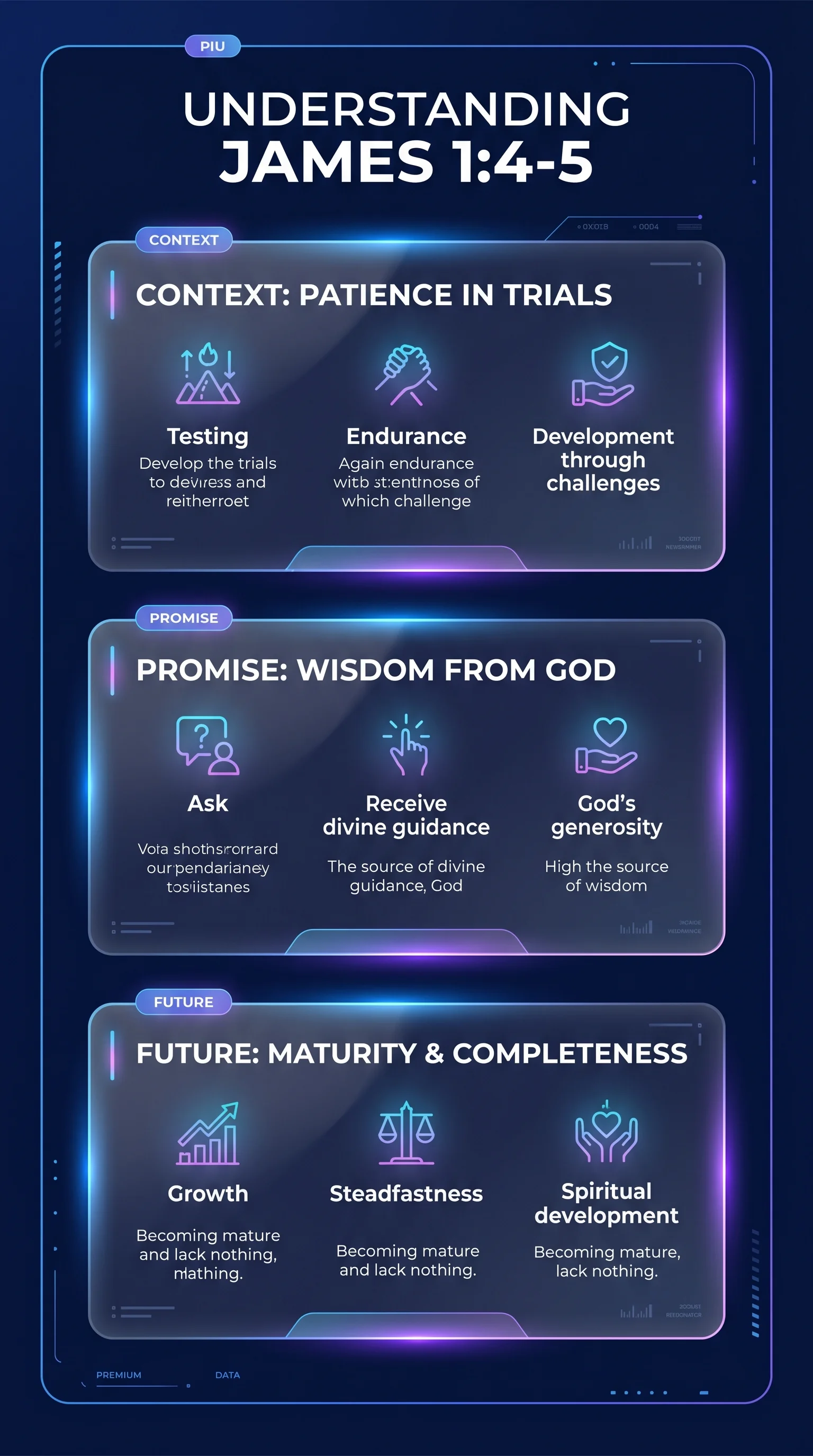
James 1:4-5
“Let endurance have its perfect work, that you may be perfect and complete, lacking in nothing. But if any of you lacks wisdom, let him ask of God, who gives to all liberally and without reproach, and it will be given to him.”

James 1:4-5 — The Beautiful Road to Unshakable Wholeness
📖 The Verse
⁴ Let endurance have its perfect work, that you may be perfect and complete, lacking in nothing. ⁵ But if any of you lacks wisdom, let him ask of God, who gives to all liberally and without reproach, and it will be given to him.
When the storms of life threaten to break you, God uses those very trials to forge an undivided, mature character within you, promising to pour out His perfect wisdom the moment you ask, without a single hint of hesitation or judgment.
To understand the raw power of these words, we have to travel back to the late AD 40s. The author of this letter is James, known in Hebrew as Jacob. He was not one of the original twelve disciples, but the half-brother of Jesus Christ Himself. After witnessing the resurrection, James went from a skeptic to the lead pastor of the mother church in Jerusalem, earning the nickname "Old Camel Knees" because of his legendary, hours-long prayer sessions on the hard temple stone. James was writing to the "Twelve Tribes of the Dispersion" (James 1:1). These were Jewish Christians who had been violently scattered from their homes in Jerusalem following the brutal martyrdom of Stephen (Acts 8:1). They were suddenly refugees, stripped of their properties, isolated from their communities, and facing intense economic exploitation and social hostility in foreign lands. They were exhausted, traumatized, and asking the agonizing question: "If God loves us, why is our world falling apart?" Literally, this letter is the New Testament's premier work of wisdom literature. It reads less like a systematic theological treatise and more like a fiery, modern-day upgrade of the Book of Proverbs, heavily saturated with the imagery and ethics of Jesus’s Sermon on the Mount. James does not offer dry, academic theories to these suffering believers; he writes with the urgent, practical, and highly visual style of an ancient prophet. In the Greco-Roman world of the first century, people viewed suffering either through the lens of Stoicism—which taught humans to suppress their emotions and grit their teeth—or through pagan fatalism, which viewed trials as the cruel whims of temperamental gods. James shatters both of these mindsets. He introduces a revolutionary perspective: trials are not random, meaningless accidents of fate, but the purposeful workshop of a loving, deeply committed Father who is actively designing our spiritual maturity.
🔍 Original Language Deep Dive
The Original Text: ὑπομονή (hypomone), τέλειος (teleios), ὁλόκληρος (holokleros), ἁπλῶς (haplōs), ὀνειδίζω (oneidizō) When we peel back the English translation and look at the original Koine Greek, the words of James explode with vivid, life-altering nuance that we often miss in our modern translations. Key Word Breakdown:
- ὑπομονή (hypomone) — This word is often translated as "endurance" or "patience," but it is far from passive. It is a compound word: hypo meaning "under," and meno meaning "to abide or remain." It describes the triumphant capacity to stay under a crushing weight without breaking, converting a trial into a glorious victory. It is the steady, active fortitude of a soldier who holds the line in the heat of battle, refusing to retreat even when the pressure is immense.
- τέλειος (teleios) — Translated as "perfect," this does not mean flawless or sinless in the modern sense. It refers to reaching an intended end, being fully developed, mature, or brought to its ultimate completion. It is the picture of a tiny seed that has successfully grown into a massive, fruit-bearing tree, fulfilling the exact design of its creator.
- ὁλόκληρος (holokleros) — Translated as "complete," this word literally means "all portions intact" or "undivided." In ancient Greek culture, it was used to describe a sacrificial animal that was completely healthy, without any blemish, or a priest who was physically sound. Spiritually, it means being integrated, whole, and consistent, where there is no gap between what we believe and how we live.
- ἁπλῶς (haplōs) — This word describes how God gives wisdom, translated as "liberally" or "generously." Its root meaning is "singly" or "simultaneously." It paints a picture of a single-minded giver who has no double motives, no hidden agendas, and no fine print. God does not hold back, calculate His losses, or give with a divided heart; He pours out His grace with absolute, unfiltered simplicity.
- ὀνειδίζω (oneidizō) — This means "to reproach," "to upbraid," or "to throw someone's past failures back in their face." In the ancient honor-shame culture, asking for help was a highly risky vulnerability that could lead to public humiliation. James uses this word to assure us that when we come to God in our bankruptcy, He will never scold us, lecture us about how we got into this mess, or make us feel small for needing Him.
🔥 Life-Giving Significance
This passage is deeply woven into the grand, four-fold story of Scripture: Creation, Fall, Redemption, and Restoration. In the beginning, God created humanity to be holokleros—whole, complete, and in perfect harmony with Him (Genesis 1:31). We were designed to walk in divine wisdom, reflecting His beautiful character in the garden. However, the Fall fractured that wholeness (Genesis 3). Sin introduced a deep, systemic brokenness that divided our hearts, darkened our minds, and left us spiritually bankrupt, lacking the wisdom to navigate life. We became double-minded, constantly searching for life and direction apart from our Creator. But God, in His infinite mercy, did not leave us in our fractured state. Redemption entered the world through Jesus Christ, who is the ultimate embodiment of both hypomone and teleios. On the cross, Jesus endured the ultimate trial, remaining steadfast under the crushing weight of our sin so that we could be redeemed (Hebrews 12:2). He is the very "wisdom of God" made manifest to us (1 Corinthians 1:30). Now, through the indwelling of the Holy Spirit, God uses the trials of this life as a sanctifying forge. He does not always rescue us from the fire; rather, He meets us in the fire to burn away our self-reliance and double-mindedness (1 Peter 1:6-7). This process of endurance is how the Spirit painstakingly restores the image of Christ within us, piece by piece. Ultimately, this passage points forward to our final Restoration. The trials we face today are not permanent; they are the painful but necessary labor pains of a new creation. When Christ returns, the work of endurance will be finished, and we will finally stand before Him fully teleios and holokleros, lacking absolutely nothing for all eternity (Revelation 21:3-4).
✨ Key Insights
- Trials Have a Divine Assignment: Difficulties are not obstacles to our spiritual growth; they are the primary instruments God uses to produce mature endurance (Romans 5:3-4).
- Maturity Requires Staying Under: True spiritual wholeness cannot be fast-tracked; we must let endurance complete its work rather than trying to escape the pressure prematurely.
- The Definition of Wholeness: God's ultimate goal for your life is not mere comfort, but an integrated, undivided character that remains rock-solid regardless of external circumstances.
- Wisdom is Not Just Information: The wisdom James speaks of is the practical, heaven-sent ability to see our trials from God's perspective and make choices that honor Him.
- God's Character is Joyfully Generous: When we ask God for help, we are not appealing to a reluctant judge, but to a lavish Giver who delights in meeting our needs.
- A Safe Place for Our Weakness: God never weaponizes our ignorance or past failures against us; His throne of grace is entirely free from scolding and reproach (Hebrews 4:16).
📚 Cross-Reference Treasury
-
Romans 5:3-4 (WEBU)
"Not only this, but we also rejoice in our sufferings, knowing that suffering produces endurance; and endurance, approved character; and approved character, hope;"
This passage directly echoes James's teaching, showing that suffering is not wasted but is the direct pathway to building a resilient, hope-filled character.
-
Matthew 7:7-8 (WEBU)
"Ask, and it will be given you. Seek, and you will find. Knock, and it will be opened to you. For everyone who asks receives. He who seeks finds. To him who knocks it will be opened."
Jesus Himself guarantees that God is an incredibly responsive Father who eagerly answers the prayers of His children when they seek His help.
-
Proverbs 2:6 (WEBU)
"For Yahweh gives wisdom. Out of his mouth comes knowledge and understanding."
This Old Testament wisdom foundation confirms that true, life-navigating wisdom is a divine gift that originates directly from the character and voice of God.
-
Hebrews 12:1-2 (WEBU)
"Therefore let’s also, seeing we are bound about with so great a cloud of witnesses, lay aside every weight, and the sin which so easily entangles us, and let’s run with endurance the race that is set before us, looking to Jesus, the author and perfecter of faith, who for the joy that was set before him endured the cross, despising shame, and has sat down at the right hand of the throne of God."
Jesus is our ultimate model of endurance, showing us that the path to glory and completion always involves staying under the weight of the cross for a greater joy.
-
Colossians 1:28 (WEBU)
"whom we proclaim, admonishing every man and teaching every man in all wisdom, that we may present every man perfect in Christ Jesus;"
Paul reinforces the ultimate goal of the Christian ministry: to see every single believer brought to full spiritual maturity and completion in Christ.
🌍 A Picture of This Truth
In the heart of the Pacific Northwest, there is a workshop belonging to a master luthier—a craftsman who spends years hand-making world-class acoustic violins. The process begins with selecting the wood. He doesn't look for soft, fast-growing pine from a sheltered valley; instead, he climbs high up the cold, wind-swept slopes of the mountains to find spruce trees that have survived decades of harsh, freezing winters. These high-altitude trees grow incredibly slowly, their grain packed tight as they fight against the constant mountain gales. That struggle, that endurance under pressure, creates wood with an incredibly dense and uniform cellular structure. It is wood that has endured. Once the wood is in his workshop, the luthier subjects it to intense heat, steam, and mechanical pressure to bend it into the perfect shape of a violin. If the wood could cry out, it would protest the carving of the sharp chisels and the relentless tension of the bending irons. Yet, if the craftsman stopped early, the wood would remain just a flat, lifeless plank. It must undergo the entire process to become an instrument capable of holding seventy-eight pounds of constant string tension without collapsing. Only through this intense process does it become "perfect and complete," ready to sing with a rich, resonant tone that captivates anyone who hears it. When the young apprentice luthier runs into a mistake or does not know how to carve the delicate scroll of the violin, he doesn't hide his mistake in fear. He walks over to the master craftsman, who has spent fifty years perfecting the art. The master doesn't roll his eyes, scold the apprentice for his lack of skill, or point to his past mistakes. He gently takes the tool, guides the apprentice's hands, and generously shares his lifelong wisdom. That is exactly the beautiful picture James is painting for us in James 1:4-5. Our trials are the high-altitude winds and the bending irons of the Master Craftsman. We are being shaped to hold the tension of this life and to sing with the beautiful music of Christlike character. And when the pressure is too much and we do not know what to do next, we don't have to hide our confusion. We can walk directly to our Heavenly Father, who stands ready to pour out His wisdom without a single word of scolding.
- Stop Trying to Escape the Process: Identify the trial you are currently trying to run away from, and ask God for the strength to "stay under" the weight, trusting that He is building something beautiful inside you.
- Perform a Spiritual Inventory: Instead of asking "Why is this happening to me?" start asking "What is this trial producing in me?" to shift your perspective from victimhood to spiritual growth.
- Confess Your Lack of Wisdom: Quietly lay down your pride, log off social media, stop relying on human opinions, and admit to God right now that you do not know how to handle your current crisis.
- Ask God with Simple Confidence: Approach God's throne today with absolute bold assurance, knowing that He is not looking at your past failures but is ready to give you the exact direction you need.
- Reject the Scolding Lie: Refuse to believe the enemy's lie that God is angry with you for being weak; remind yourself that He gives "without reproach" and welcomes your vulnerability with open arms.
🙏 Reflection & Prayer
Reflect on this: What would it look like if you stopped viewing your current struggle as an obstacle to your faith, and started viewing it as the exact instrument God is using to make you whole and complete? A Prayer for Today:
Father, I come to You today feeling fractured, tired, and deeply aware of my own limitations. I confess that my first instinct is always to run away from the pressure and to escape the trials that come my way. Please forgive me for my impatience and my self-reliance. I ask that You would grant me the grace of hypomone—the holy endurance to stay under this current trial, trusting that You are using it to make me whole, mature, and undivided. Lord, I am utterly bankrupt of wisdom right now; I do not know what decision to make, how to heal this relationship, or how to navigate this storm. I thank You that You are a generous Father who does not scold me for my ignorance or throw my past mistakes in my face. Pour out Your perfect, single-minded wisdom into my heart today, and let my life bring glory to Your name. In the mighty and precious name of Jesus, Amen.
💬 Share this deep dive with someone who needs it today — and come back tomorrow for the next Verse of the Day!