Ephesians 2:8-9
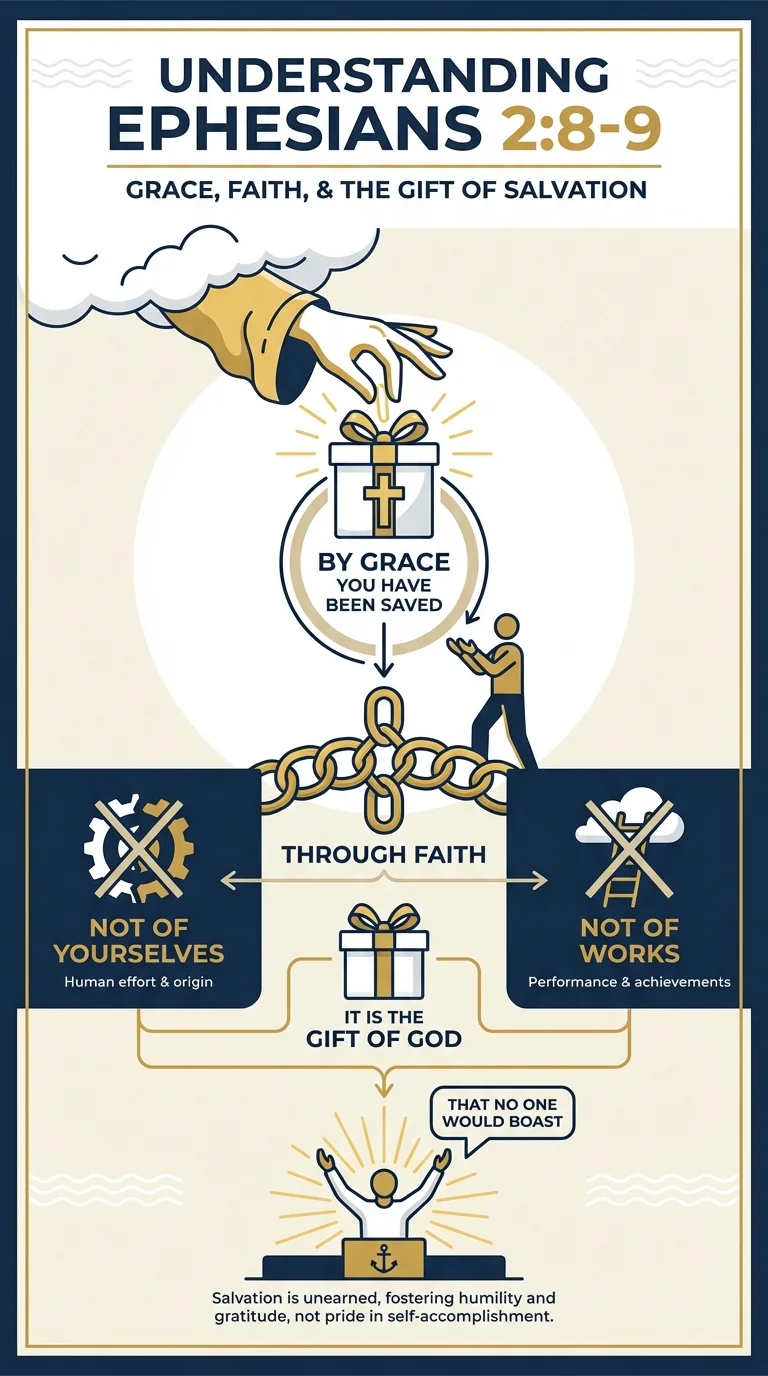
“for by grace you have been saved through faith, and that not of yourselves; it is the gift of God, not of works, that no one would boast.”
Ephesians 2:8-9 – The Grandeur of Gratuitous Grace
The Hook
In our modern meritocracy, we are conditioned from childhood to believe that we get what we pay for and we earn what we keep. Whether it is a promotion at work, a grade in school, or status on social media, the equation is simple: performance equals reward. But when we apply this transactional mindset to our relationship with God, it leads to spiritual exhaustion and crippling anxiety. Ephesians 2:8-9 shatters this paradigm, offering the most radical counter-cultural truth in history: the most valuable thing you will ever possess cannot be earned, only received.
Setting: The Apostle Paul wrote the letter to the Ephesians approximately 60–62 AD. At the time of writing, Paul was not standing in a pulpit but sitting in a prison cell, likely in Rome (Ephesians 3:1; 4:1). This context is vital; Paul writes about the boundless freedom of God’s grace while physically bound in chains. It serves as a testament that spiritual reality often supersedes physical circumstance.
Cultural Background: To fully grasp the shock value of these verses, we must understand the Greco-Roman concept of charis (grace) and the patronage system. In the first century, a gift (charis) from a wealthy patron to a client usually came with strings attached. It created a debt of obligation; the recipient was expected to repay the favor through loyalty, public praise, or service.
Furthermore, the city of Ephesus was the epicenter of the worship of Artemis. Religion there was highly transactional—offerings were made to appease the gods and secure favor for trade or health. Simultaneously, the Jewish contingent within the early church carried a history of viewing righteousness through the lens of Torah observance (the Law). Both Gentile and Jewish backgrounds were heavily invested in a "performance-based" identity. Paul’s definition of grace—unmerited, unrepayable favor that removes human boasting—was a theological earthquake.
Original Audience: The letter was a circular encyclical intended for the believers in Ephesus (a major commercial and religious hub in Asia Minor) and the surrounding house churches. This community was a volatile mix of Jews and Gentiles who were struggling to find a unified identity. Paul writes to cement their identity not in their ethnicity or their past religious performance, but in their shared reception of God's gift.
Deep Dive Analysis
Key Words Study
1. Charis (χάρις) – Grace While often defined simply as "unmerited favor," the Greek word implies a leaning of the heart toward someone. In the New Testament, it represents God’s active, loving condescension to save those who cannot save themselves. Unlike the Roman patronage system, this grace does not seek a return on investment to benefit the giver; it is entirely for the benefit of the receiver.
2. Sesōsmenoi (σεσῳσμένοι) – Have been saved This is a Perfect Passive Participle of the verb sōzō. The grammar here is theological gold.
- Passive Voice: You did not do the saving; it was done to you.
- Perfect Tense: This indicates a past completed action with permanent, continuing results. A literal translation might be: "You have been saved in the past, and you remain in a state of salvation in the present." It speaks of total security.
3. Pistis (πίστις) – Faith In this context, faith is not merely intellectual agreement (believing God exists). It implies a total reliance, a crumbling of self-sufficiency. It is the open hand that receives the gift. Faith is the instrument (the "through"), not the cause.
4. Kauchēsētai (καυχήσηται) – Boast To glory in, to vaunt oneself, or to take pride in an achievement. Paul uses this word to describe the natural human tendency to claim credit for spiritual status.
Walk Through It Verse by Verse
Verse 8: "For by grace you have been saved through faith, and that not of yourselves; it is the gift of God,"
Paul begins with the explanatory "for" (gar), linking this back to the previous verses where he described our condition as "dead in trespasses" (2:1). He establishes the source of salvation: Grace. This is the origin point. Salvation is born in the heart of God, not the will of man.
The phrase "through faith" designates the channel. If grace is the water, faith is the pipe. The water flows through the pipe, but the pipe does not produce the water.
Then comes a critical theological clause: "and that not of yourselves." There has been much scholarly debate regarding what the word "that" (touto) refers to. In Greek, "faith" is feminine, but "that" is neuter. Grammatically, this suggests that Paul is not saying only the faith is a gift (though that is true), nor only the grace. Rather, the neuter demonstrative pronoun refers to the entire antecedent process. The whole package—the grace, the salvation, the awakening from spiritual death, and the capacity to believe—is "not of yourselves."
It is unequivocally "the gift of God." A gift, by definition, ceases to be a gift the moment you try to pay for it. If you offer a penny for a billion-dollar gift, you convert it into a debt you can never pay and insult the giver. Paul is emphatic: the origin of your rescue is entirely external to you.
Verse 9: "not of works, that no one would boast."
Paul moves from the positive affirmation to the negative prohibition. "Not of works" (or ergon) excludes legal obedience, moral striving, religious rituals, and social philanthropy as grounds for acceptance by God.
Why is God so restrictive here? Why not allow us to contribute just 1% to our salvation? Paul gives the reason: "that no one would boast."
If salvation were 99% grace and 1% our effort, we would spend eternity congratulating ourselves on that 1%. We would look at those not saved and think, "They lacked the discipline I had." Heaven would become a place of ego rather than worship. By removing works entirely from the equation of justification, God ensures that all glory goes to Him alone. The leveling ground of the cross means the worst sinner and the most moral saint enter by the exact same door.
life-giving Significance
Key Themes
1. Sola Gratia (Grace Alone) This passage is the bedrock of evangelical theology regarding monergism—the idea that God is the sole active agent in regeneration. This theme asserts that human beings, being spiritually dead (Eph 2:1), cannot cooperate with God to effect their own resurrection. Just as a dead man cannot perform CPR on himself, a sinner cannot generate the righteousness required for salvation. God’s grace is not a reward for the righteous, but a rescue for the rebellious.
2. The Rejection of Anthropocentric Glory Human religion is naturally anthropocentric (man-centered). We crave agency and credit. This passage establishes a Theocentric (God-centered) soteriology. The ultimate end of salvation is not just man’s happiness, but God’s glory. By stripping man of the ability to boast, God secures the worship that is rightfullly His. This theme protects the holiness of God by refusing to mix human failure with divine perfection.
Gospel Connection
Ephesians 2:8-9 is the Gospel in miniature. It points directly to the finished work of Jesus. For salvation to be "not of works" for us, it had to be "of works" for Christ. He performed the perfect obedience we could not (the active obedience of Christ) and took the penalty for the disobedience we committed (the passive obedience of Christ).
Because Jesus cried out "It is finished" on the cross, we can rest in the truth that "it is the gift." The text drives us away from introspection (looking at our own performance) and directs us to look outward at Christ's performance on our behalf.
Reflection Questions
- Introspective: In what specific areas of your life do you still feel the need to "earn" God's love or approval? (e.g., rigid quiet times, service at church, moral superiority).
- Relational: How does the truth that you are saved by grace alone change how you view people who are living in open sin or who have different political/social views than you? Does it kill your sense of superiority?
- Action-Oriented: If you truly believed that your salvation was a settled, non-refundable gift, how would that change your anxiety levels regarding your current struggles or failures?
This Week's Challenge
The Grace Audit: For the next seven days, every time you do something "spiritual" (pray, read the Bible, serve, give money), pause and ask yourself: Am I doing this to be saved, or because I am saved?
- If you catch yourself doing it to earn favor, stop. Pray: "God, I cannot buy you. I receive your love for free."
- If you are doing it out of gratitude, continue with joy. Journal these moments to identify where a "works-based" mentality is hiding in your heart.
Prayer
Father of all mercies, I confess that I am addicted to my own achievements. I naturally want to bring You my resume, but You only ask for my trust. Thank You that salvation is Your gift, not my wage. Thank You that when I could not reach up to You, You reached down to me. Shatter my pride, silence my boasting, and let my life be a joyful reaction to the stunning reality that I am saved by grace alone. In the name of Jesus, who paid it all, Amen.