Psalms 121:1-2
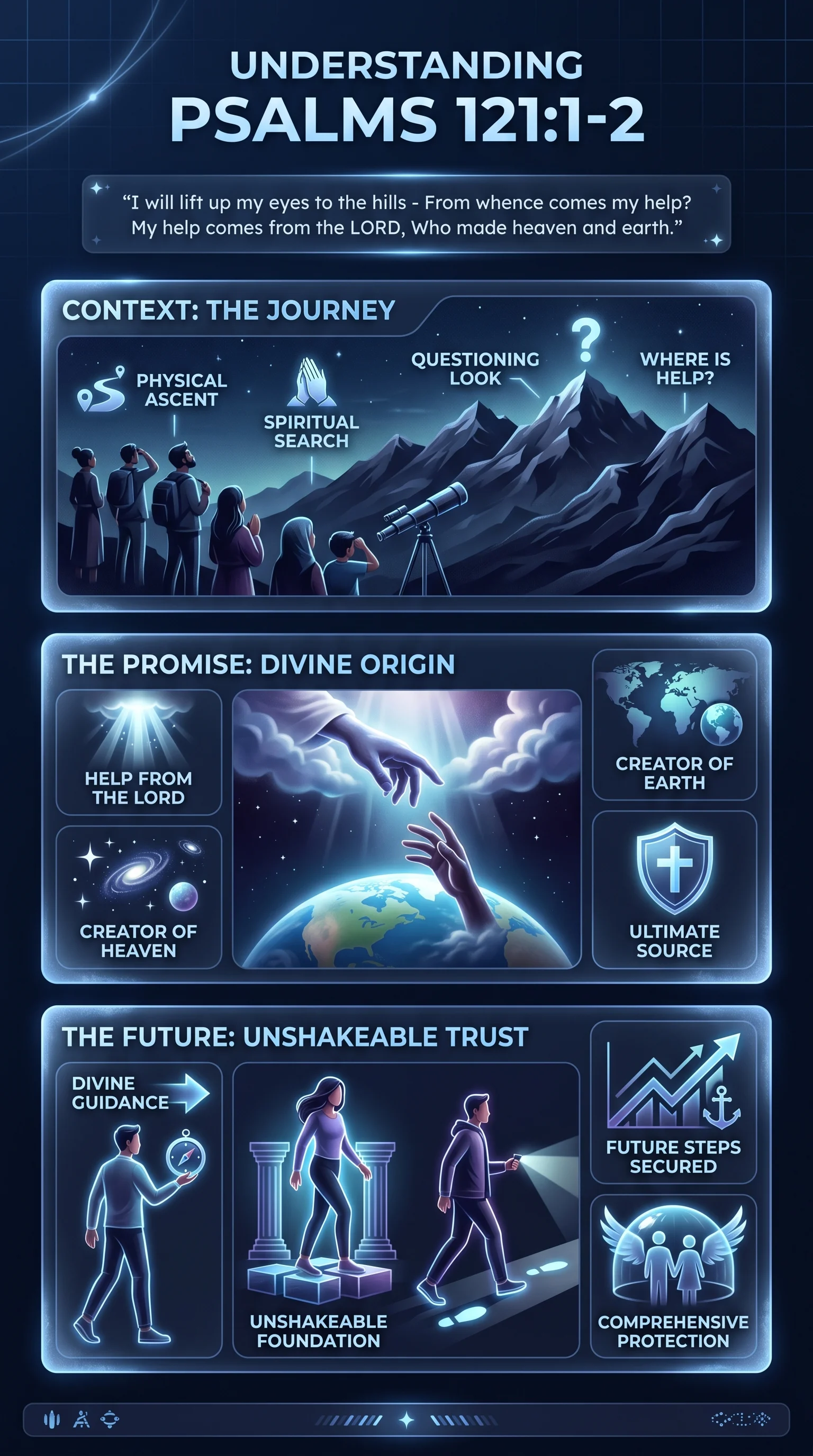
“I will lift up my eyes to the hills. Where does my help come from? My help comes from the LORD, who made heaven and earth.”

Psalms 121:1-2 — Help From the Maker of All Things
📖 The Verse
¹ I will lift up my eyes to the hills. Where does my help come from? ² My help comes from the LORD, who made heaven and earth.
When the obstacles in front of you look like insurmountable mountains, remember that your rescue comes directly from the One who carved them.
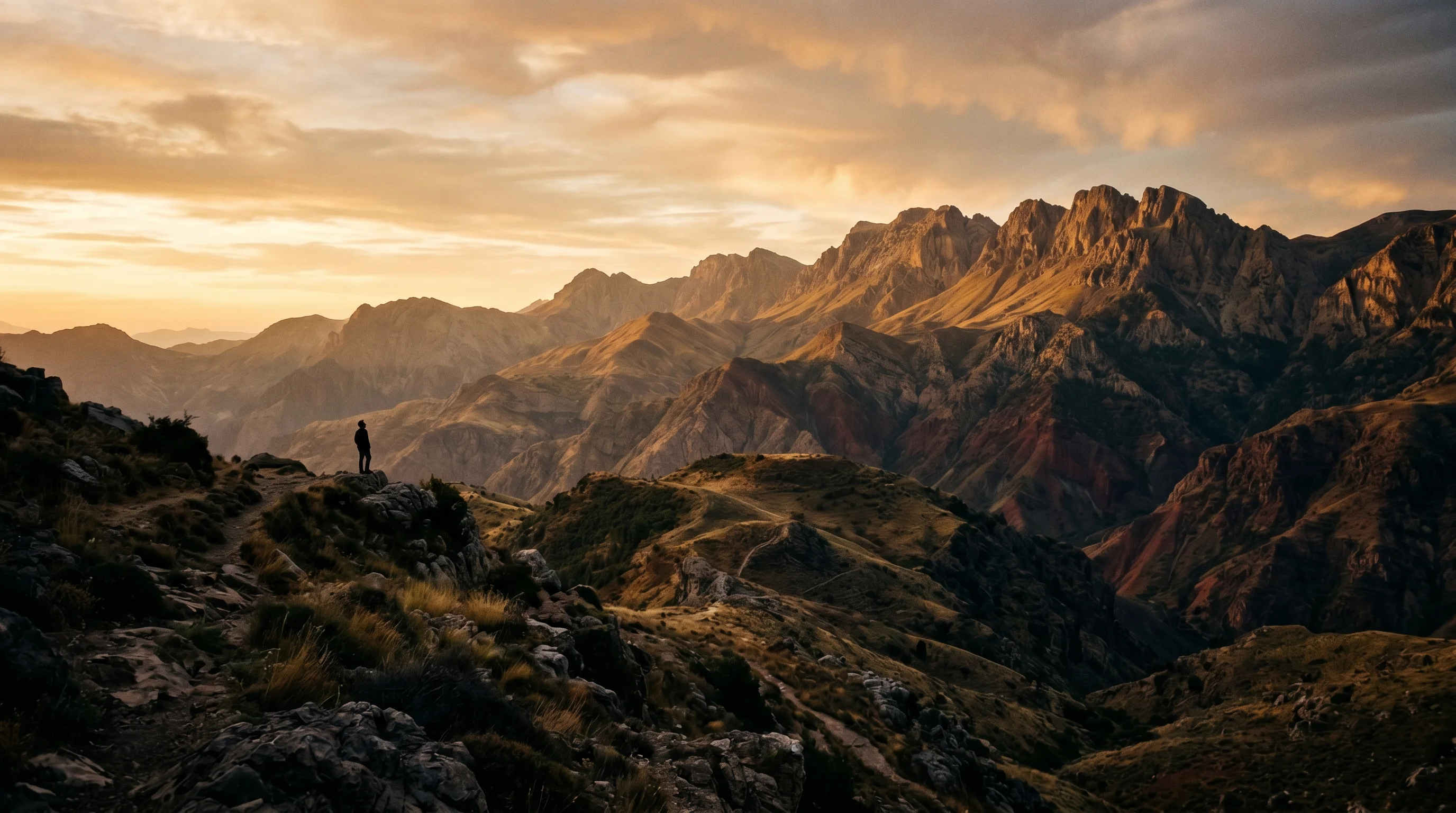
Psalm 121 is the second of fifteen "Songs of Ascents" found in the book of Psalms (Psalms 120-134). These were ancient pilgrim songs, sung passionately by the Israelites as they traveled the steep, winding, and often dangerous roads upward toward Jerusalem. They made this trek for the three great annual festivals: Passover, Pentecost, and the Feast of Tabernacles. The physical journey to Jerusalem was exhausting and fraught with peril. Bandits, thieves, and wild animals frequently hid in the very hills, ravines, and caves the travelers had to navigate. When an ancient pilgrim looked up at the mountains, they were not just admiring a beautiful landscape—they were scanning the rocks for danger, wondering if an ambush awaited them around the next bend. Against this backdrop of deep vulnerability, the psalmist poses a raw, pressing question: "Where does my help come from?" The author is not writing from the safety of a fortified palace, but from a dusty, sun-baked road where the threat of robbery or injury was a daily reality. The hills represented both the physical route to God's presence in Zion and the immediate, terrifying obstacles standing in the way. Culturally, the surrounding pagan nations actively built their altars—known as "high places"—on these hilltops, seeking protection from false idols and local deities. The psalmist makes a radical, faith-filled declaration in response. He refuses to look to the pagan shrines on the hills, nor will he cower in fear at the bandits hiding in the rocks. His eyes look straight past the mountains to the very Creator of the mountains.
🔍 Original Language Deep Dive
The Original Text: אֶשָּׂא עֵינַי אֶל־הֶהָרִים מֵאַיִן יָבֹא עֶזְרִי׃ עֶזְרִי מֵעִם יְהוָה עֹשֵׂה שָׁמַיִם וָאָרֶץ׃ (’essa’ ‘eynay ‘el-heharim me’ayin yavo’ ‘ezri. ‘ezri me‘im Yahweh ‘oseh shamayim wa’arets.) The literal Hebrew translation brilliantly shifts the focus from a terrifying geographic location to the supreme authority of God. The psalmist physically looks upward, acknowledges that the mountains cannot save him, and declares that his true defense arrives personally from the active, working hands of the Creator. Key Word Breakdown:
- אֶשָּׂא ('essa') — Meaning "I will lift up" or "I will raise." This is not a casual, fleeting glance; it is a deliberate, intentional lifting of the gaze. Spiritually, it represents a definitive choice to shift our focus away from the dirt of our circumstances and elevate our perspective toward the reality of God's presence.
- הֶהָרִים (heharim) — Meaning "the mountains" or "the hills." In the ancient Near East, mountains were seen as places of refuge, military strongholds, and the dwelling places of various deities. The psalmist recognizes that no earthly fortress, geographical high point, or human alliance can provide the ultimate security his soul desperately requires.
- עֶזְרִי ('ezri) — Meaning "my help" or "my succor." This word is frequently used in ancient military contexts to describe heavy reinforcements arriving in the absolute thick of battle. It reveals that God does not merely send good advice from a distance; He sends active, rescuing intervention when we are completely outmatched.
- יְהוָה (Yahweh) — Meaning "The LORD," the covenant-keeping, self-existent God of Israel. By using God's personal, revealed name rather than a generic title for deity, the writer anchors his hope in a God who makes and keeps blood covenants. This is the God of Abraham, intimately involved and fiercely loyal to His people.
- עֹשֵׂה ('oseh) — Meaning "Maker" or "Creator," derived from the primary Hebrew verb to make or do. It is an active participle, implying that God did not just build the world, wind it up like a clock, and walk away. He is the continually active Maker of all things, intimately sustaining creation and actively shaping the lives of His children today.
🔥 Life-Giving Significance
Psalm 121 anchors the believer's absolute security firmly in the foundational doctrine of Creation. When the psalmist identifies the LORD as the one "who made heaven and earth," he is establishing the total, unrivaled sovereignty of God over all things. If God possesses the unimaginable power to speak galaxies into existence and sculpt the bedrock of the earth, then He possesses both the authority and the power to intervene in our daily struggles. Our help comes from the supreme Architect of reality itself. This Old Testament passage points beautifully forward to the redemptive, finished work of Jesus Christ. Just as the ancient pilgrims looked to the hills on their treacherous way to Jerusalem, Jesus literally set His face like flint toward Jerusalem, ascending the ultimate hill—Golgotha. On that cross, Jesus became our very present help in trouble. He conquered sin, sickness, death, and the grave, proving that the Maker of all things is also the Redeemer of all things, willingly pouring out His blood to restore us to the Father. As believers who trust in the full gospel, we also see the profound promise of the Holy Spirit echoed loudly in this text. Jesus promised that when He returned to the Father, He would send us another "Helper" to endue us with power from on high. The active, intervening rescue that the ancient psalmist anticipated from Yahweh is now intimately available to us through the indwelling, miraculous presence of the Holy Spirit. We do not walk this pilgrim road alone; the Spirit of the Living God walks with us, empowers us, and heals us along the journey.
✨ Key Insights
- The Choice to Look Up: The decision to "lift up my eyes" is a powerful act of defiance against the spirit of fear. We must intentionally pull our vision away from our present anxieties, medical reports, and financial stress, and lock our gaze firmly onto the Lord.
- The Inadequacy of Earthly Refuge: The hills represent both threats and false sanctuaries that tempt us today. God wants us to realize that money, status, political power, or human alliances are entirely insufficient saviors; only He can truly protect us.
- Heavenly Reinforcements: The Hebrew concept for "help" implies a dramatic military rescue. God is not a passive, distant observer watching you struggle on the road; He is the Commander of heaven's armies, actively dispatching grace, strength, and angels exactly when you need them.
- The Promise-Keeping Name: The deliberate use of "LORD" (Yahweh) reminds us that our ultimate helper is a relentless promise-keeper. He is bound to us by the new covenant in Christ's blood, guaranteeing that He will never abandon His own in the heat of the battle.
- Creator Power Applied to You: The exact same unmatched power that ignited the sun, placed the stars, and shaped the mountains is now personally directed toward your preservation. You are guarded by omnipotence.
- The Pilgrim's Reality: We are simply travelers passing through a hostile, broken world. Expecting friction on the journey is not a lack of faith; knowing exactly who to call upon when the friction comes is the very essence of faith.
📚 Cross-Reference Treasury
- Genesis 1:1 — "In the beginning, God created the heavens and the earth." This foundational truth establishes that the Maker of all things has unlimited, sovereign power to intervene miraculously in our lives today.
- Psalms 46:1 — "God is our refuge and strength, a very present help in trouble." This confirms that the military-style rescue and help promised in Psalm 121 is always immediately available to the believer, no matter the circumstance.
- Hebrews 4:16 — "Let’s therefore draw near with boldness to the throne of grace, that we may receive mercy and may find grace for help in time of need." The New Testament reveals that because of Jesus' sacrifice, we can boldly approach God for the exact rescuing help the psalmist wrote about.
- John 14:16 — "I will pray to the Father, and he will give you another Counselor, that he may be with you forever." Jesus fulfills the ancient promise of divine help by sending the Holy Spirit to continually abide, comfort, and empower us on our earthly pilgrimage.
🌍 A Picture of This Truth
Imagine a young child who has just learned to ride a bicycle without training wheels for the very first time. They are pedaling furiously down a long, slightly uneven neighborhood sidewalk, their knuckles white with concentration. Suddenly, a large, aggressive dog breaks free from a neighbor's yard and bounds toward the sidewalk, barking fiercely and blocking the path forward. The child's immediate, terrifying reaction is to stare completely fixed on the immediate threat—the snarling dog. But in a split second, the child lifts their eyes past the dog and looks down the street to the figure standing firmly at the corner. It is their father. The father isn't just a spectator sitting on a porch; he is strong, he deeply loves his child, and he immediately steps off the curb, sprinting to place himself entirely between the child and the danger. The child didn't need to try and fight the dog. They didn't need to try and pedal faster than an animal that could outrun them. They simply needed to lift their eyes to the one who had the authority and the strength to handle the threat. The father's immediate presence changed the entire dynamic of the terrifying situation, turning paralyzing panic into profound, unspeakable security. That is exactly what the psalmist is saying in Psalms 121:1-2. When you look up from the terrors of the road and lock your eyes with the Father who made heaven and earth, your panic is replaced by His powerful presence. As Psalms 46:1 reminds us, "God is our refuge and strength, a very present help in trouble."
- Audit Your Focus: When anxiety hits you today, pay close attention to where your eyes go first. Are you staring endlessly at your banking app, the news cycle, or the medical report? Practice physically looking up, pausing for a moment, and verbally declaring out loud that your help comes from the Lord.
- Stop Trusting the "Hills": Identify the earthly hills you have secretly been looking to for security—whether it is a job title, a romantic relationship, your savings account, or your own intellect. Consciously release your tight grip on them today and transfer your trust fully to the Creator.
- Welcome the Holy Spirit’s Reinforcement: If you feel completely overwhelmed by parenting, work, or grief, stop trying to fight the battle in your own exhausted strength. Ask the Holy Spirit to fill you afresh today, bringing the active, intervening help and comfort that Jesus promised.
- Embrace the Pilgrim Journey: Acknowledge that you are a pilgrim walking through temporary territory. If you are facing uphill battles or rough terrain today, do not be surprised or discouraged. The presence of trouble does not mean God has left you; it is the very environment where His miraculous help shines the brightest.
- Praise the Creator’s Power: Spend five minutes today simply thanking God for the sheer magnitude of His creative power. Go outside, look at the sky, a mountain, or a simple tree, and remind your weary soul that the God who engineered all things is the exact same God managing the details of your life.
🙏 Reflection & Prayer
Reflect on this: Where are you currently looking for rescue in your life, and what would it look like today if you entirely shifted your expectation of help away from your own limited resources and firmly onto the Maker of all things? A Prayer for Today:
Lord Jesus, I confess that too often I keep my eyes glued to the problems, terrors, and anxieties right in front of me. I catch myself looking to my own strength, my bank account, or other people to save me from the storms of life. Today, I am making the deliberate, faith-filled choice to lift my eyes higher. I am looking straight past the mountains of my circumstances and fixing my gaze entirely on You, the Maker of heaven and earth. Thank You for being a very present help in my time of trouble and for never abandoning me on this journey. Holy Spirit, flood my heart with the absolute certainty that the Creator of all things is fiercely watching over my life today. Give me the grace to rest completely in Your unmatched power. In Jesus' mighty name, Amen.
💬 Share this deep dive with someone who needs it today — and come back tomorrow for the next Verse of the Day!