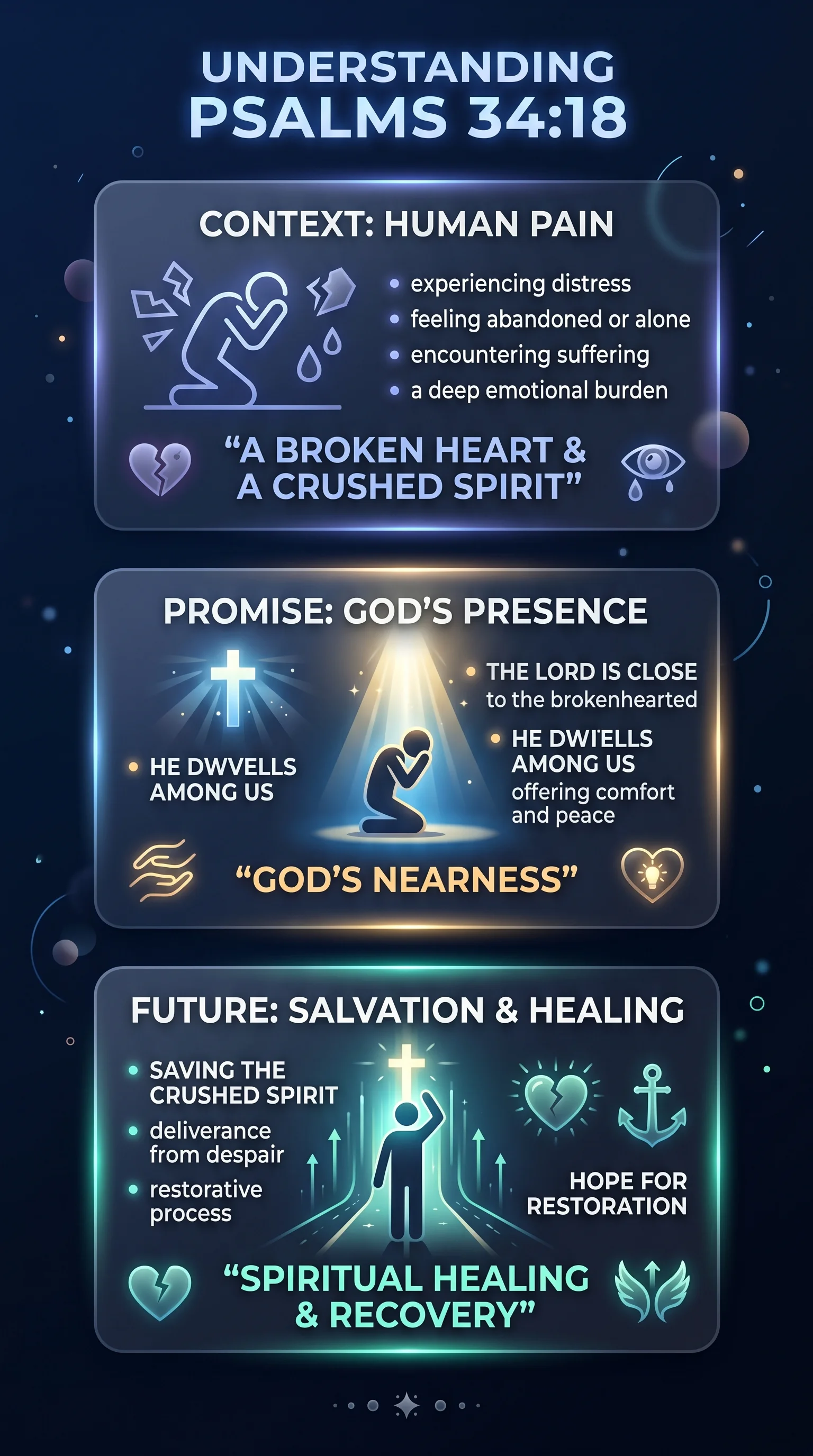
Psalms 34:18
“The LORD is near to those who have a broken heart, and saves those who have a crushed spirit.”

Psalms 34:18 — When Your Heart Shatters, God Draws Near
📖 The Verse
¹⁸ The LORD is near to those who have a broken heart, and saves those who have a crushed spirit.
In a culture that demands we constantly broadcast our polished highlights, God bypasses our pretending to intimately pursue us in our most shattered, desperate seasons.
To truly grasp the power of this verse, we must understand the terrifying situation that birthed it. David wrote Psalm 34 during one of the most humiliating and perilous chapters of his life. Though he carried the anointing of a future king, he was currently living as a desperate fugitive, fleeing from the murderous jealousy of King Saul. Running out of options, David sought asylum in the Philistine city of Gath—the hometown of Goliath, the very giant David had killed. When the locals recognized him, David was trapped behind enemy lines. To save his own life, he had to pretend to be completely insane, scratching at the city doors and letting spit run down his beard (recorded in 1 Samuel 21). David was entirely alone, stripped of his dignity, hunted like an animal, and profoundly terrified. He was writing from the absolute rock bottom of human experience. Yet, in the aftermath of this harrowing escape, sitting in the damp, dark Cave of Adullam, David did not write a song of despair. Instead, he composed Psalm 34 as an acrostic poem, where each verse begins with a successive letter of the Hebrew alphabet. This literary style was a brilliant memory aid for the Israelites, but it also carried a profound theological message. David was declaring that from Aleph to Tav—from A to Z—God’s sovereign presence covers every single aspect of our lives, even the chaotic, traumatic, and broken moments.
🔍 Original Language Deep Dive
The Original Text: קָרוֹב יְהוָה לְנִשְׁבְּרֵי־לֵב וְאֶת־דַּכְּאֵי־רוּחַ יוֹשִׁיעַ (Qarov Adonai l'nishberei-lev, v'et-dakk'ei-ruach yoshia) The profound beauty of this verse is unlocked when we look at the physical, visceral imagery the Hebrew language uses to describe our emotional and spiritual pain. Key Word Breakdown:
- קָרוֹב (qarov) — This word means "near, adjacent, or close enough to touch." It is not a theoretical or distant nearness, but an intimate, immediate proximity. It reveals a God who doesn't just watch our suffering from heaven, but steps directly into our personal space to comfort us.
- נִשְׁבְּרֵי (nishberei) — Meaning "broken, shattered, or ruptured." It paints the picture of a clay pot that has been dashed against the ground and violently broken into disconnected pieces. It describes a heart that has been fractured by grief, betrayal, or profound loss.
- לֵב (lev) — This is the Hebrew word for "heart," but it encompasses far more than the physical organ or mere emotions. In ancient Jewish thought, the lev is the inner person, the seat of the mind, will, courage, and conscience. When the lev is broken, your very core is fractured.
- דַּכְּאֵי (dakk'ei) — Meaning "crushed, pulverized, or beaten to dust." This describes a heavy, oppressive weight that grinds something down until nothing is left. It is the perfect ancient articulation of what we today might call severe depression, overwhelming anxiety, or absolute burnout.
- יוֹשִׁיעַ (yoshia) — Meaning "saves, delivers, or rescues." Derived from the root word yasha (the same root as the name of Jesus), it literally means to be brought out of a tight, restrictive space and into a wide, open, safe place. God actively delivers the crushed spirit into freedom.
🔥 Life-Giving Significance
This passage beautifully captures the breathtaking paradox of God's character throughout the grand narrative of Scripture. In the Fall, human sin fractured our relationship with God, bringing brokenness, decay, and crushing sorrow into God's perfect Creation. Human logic dictates that perfection should recoil from brokenness, and that an infinitely holy God would pull away from our messy, ruined state. Yet, the redemptive storyline of the Bible reveals the exact opposite: our brokenness is the very magnet that draws God’s grace. He is not repelled by our shattered pieces; He moves toward them. This ancient promise finds its ultimate, flesh-and-blood fulfillment in the Lord Jesus Christ. In the Incarnation, God literally drew near to a broken world (John 1:14). Jesus inaugurated His earthly ministry by declaring that He was sent specifically to heal the brokenhearted and bring liberty to the captives (Luke 4:18). On the cross, Jesus allowed His own body to be broken and His spirit to carry the crushing weight of the world's sin. He absorbed our profound brokenness so that we could inherit His perfect wholeness. For the believer today, this verse perfectly foreshadows the ministry of the Holy Spirit. Jesus promised to send the Comforter, the Paraclete—a Greek term literally meaning "one called alongside to help." Through the baptism and indwelling presence of the Holy Spirit, God fulfills Psalm 34:18 continuously. Salvation here is not just a future ticket to heaven; it is the present-tense, active rescue of our minds and spirits from the crushing weight of despair. When we reach the absolute end of our own strength, the Spirit of God draws intimately near, bringing divine healing and supernatural peace.
✨ Key Insights
- God is attracted to your weakness: We mistakenly believe we must clean ourselves up to enter God's presence. In reality, a shattered, contrite heart is the very condition that invites His deepest intimacy and grace.
- Proximity is the promise: In this verse, God does not immediately promise to explain why the pain happened. His first and greatest provision is His immediate, comforting presence in the pain.
- Your shattered pieces have value: In the ancient world, a broken clay vessel was swept up and thrown into the garbage. God, however, takes the shattered pieces of our lives and uses them to craft His greatest redemptive testimonies.
- Crushed to the core: A "crushed spirit" implies having absolutely nothing left to give. Arriving at the utter end of your own strength is not a failure; it is the precise starting line for true spiritual dependence.
- Salvation is a present reality: The rescue promised here is an active deliverance. God is continuously at work, pulling your mind and spirit out from under the paralyzing, heavy weight of earthly sorrow.
- Praise from the pit: David penned these words right after acting like a madman to escape execution. This proves that we do not need perfect, peaceful circumstances to experience the perfect, rescuing peace of God.
📚 Cross-Reference Treasury
- Psalms 51:17 — "The sacrifices of God are a broken spirit. A broken and contrite heart, O God, you will not despise." This confirms that God values our authentic vulnerability far more than our religious performance.
- Isaiah 61:1 — "The Lord Yahweh’s Spirit is on me; because Yahweh has anointed me to preach good news to the humble. He has sent me to bind up the broken hearted..." This prophetic text, which Jesus later claimed as His own mission, perfectly mirrors God's rescuing nature.
- Matthew 5:4 — "Blessed are those who mourn, for they shall be comforted." Jesus echoes Psalm 34, promising that deep sorrow will be met directly by divine comfort.
- 2 Corinthians 1:3-4 — "Blessed be the God and Father of our Lord Jesus Christ, the Father of mercies and God of all comfort; who comforts us in all our affliction..." Paul reiterates that God’s nearness in our pain equips us to help others in theirs.
- Revelation 21:4 — "He will wipe away every tear from their eyes. Death will be no more; neither will there be mourning, nor crying, nor pain, any more. The first things have passed away." This is the ultimate fulfillment of God’s salvation, where the crushed spirit is eternally healed in the restored Creation.
🌍 A Picture of This Truth
Imagine a young child who has spent hours painstakingly building a masterpiece—a towering structure of complex building blocks. They have poured their entire afternoon into getting every piece exactly right. Suddenly, a careless accident happens. A sibling runs by, the table is violently bumped, and the entire creation crashes to the hardwood floor, shattering into hundreds of disconnected, jagged pieces. The child doesn't just cry; they are completely undone. They drop to their knees in the middle of the wreckage, overwhelmed by the sheer impossibility of putting it all back together. Their little heart is genuinely broken over what was suddenly and unfairly lost. A loving parent doesn't stand across the room shouting instructions on how to rebuild the tower. They don't pull out a manual, and they certainly don't scold the child for weeping or tell them to hurry up and get over it. Instead, the parent drops to their knees, ignoring the sharp edges scattered on the floor, and moves right into the center of the mess. The parent pulls the weeping child into a tight embrace, becoming a steady, comforting anchor in the midst of the ruin. Only after holding the child—only after establishing that intimate nearness—does the parent begin to use their strong, capable hands to help gather the shattered pieces and rebuild something entirely new. The rescue does not begin with an instruction manual; the rescue begins with proximity. That is exactly what the Lord is saying in Psalms 34:18. God doesn't shout cold advice from heaven when our lives fall apart; He steps directly into the wreckage of our pain, drawing intimately near to our broken hearts before He begins the beautiful work of saving and rebuilding our crushed spirits.
- Bring God the unedited pieces: Stop trying to hide your pain behind a polite, religious filter. In prayer today, bring the raw, shattered, and confused pieces of your heart directly to the Lord without trying to clean them up first.
- Reframe your exhaustion: If you are dealing with a "crushed spirit" from intense work stress, family anxiety, or grief, recognize that hitting a wall is not a spiritual failure. It is an invitation to stop striving and let God's rescuing power take over.
- Practice the ministry of presence: When comforting a grieving friend or family member, prioritize your physical and emotional presence over offering theological solutions. Just be "near" to them, reflecting the character of God.
- Invite the Holy Spirit into your atmosphere: If anxiety feels like a physical weight pressing down on you today, pause and verbally invite the Holy Spirit to breathe His peace into your immediate environment. Let Him fulfill His role as your Comforter.
- Release the guilt of your brokenness: Understand that your difficult season does not disqualify you from God's love or usefulness. Your brokenness actually attracts His deepest compassion. Allow Him to heal you at His pace.
🙏 Reflection & Prayer
Reflect on this: Where are you currently trying to hide your broken pieces from God, and what would it look like if you stopped pretending you were fine, and instead let Him draw near to your shattered heart today? A Prayer for Today:
Lord Jesus, I come to You today with pieces of my life that feel broken and heavy. There are parts of my spirit that feel crushed by the weight of anxiety, grief, and the pressures of this world. Thank You that You do not run away from my mess, but instead, You draw intimately near to me in my lowest moments. Forgive me for the times I have tried to fix everything in my own strength, pretending I didn't need Your help. Holy Spirit, please breathe Your divine comfort into my shattered heart right now. Rescue my mind from despair, hold me in Your presence, and carefully rebuild my life according to Your perfect will. In Jesus' mighty name I pray, Amen.
💬 Share this deep dive with someone who needs it today — and come back tomorrow for the next Verse of the Day!