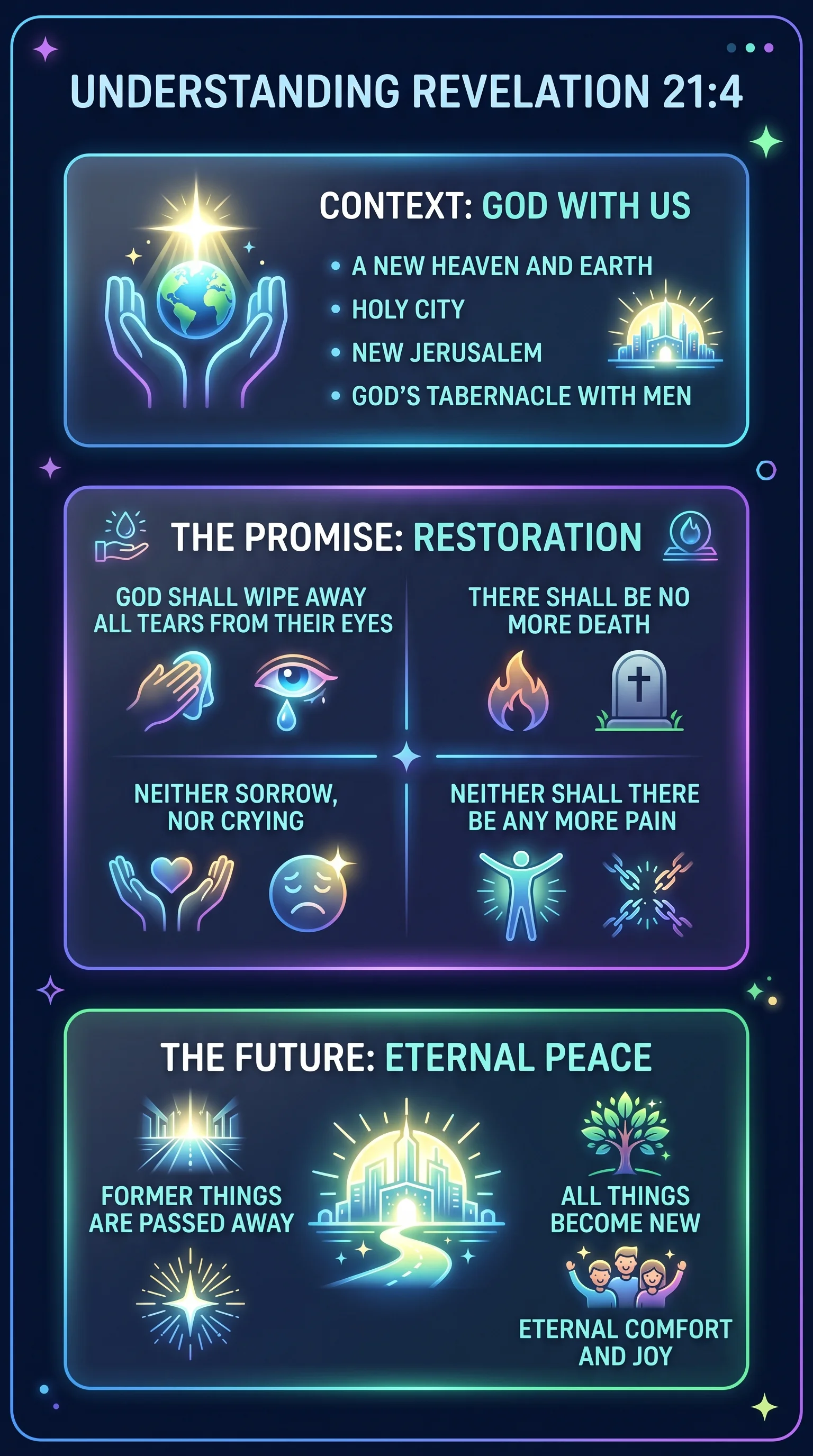
Revelation 21:4
“He will wipe away every tear from their eyes. Death will be no more; neither will there be mourning, nor crying, nor pain any more. The first things have passed away.”
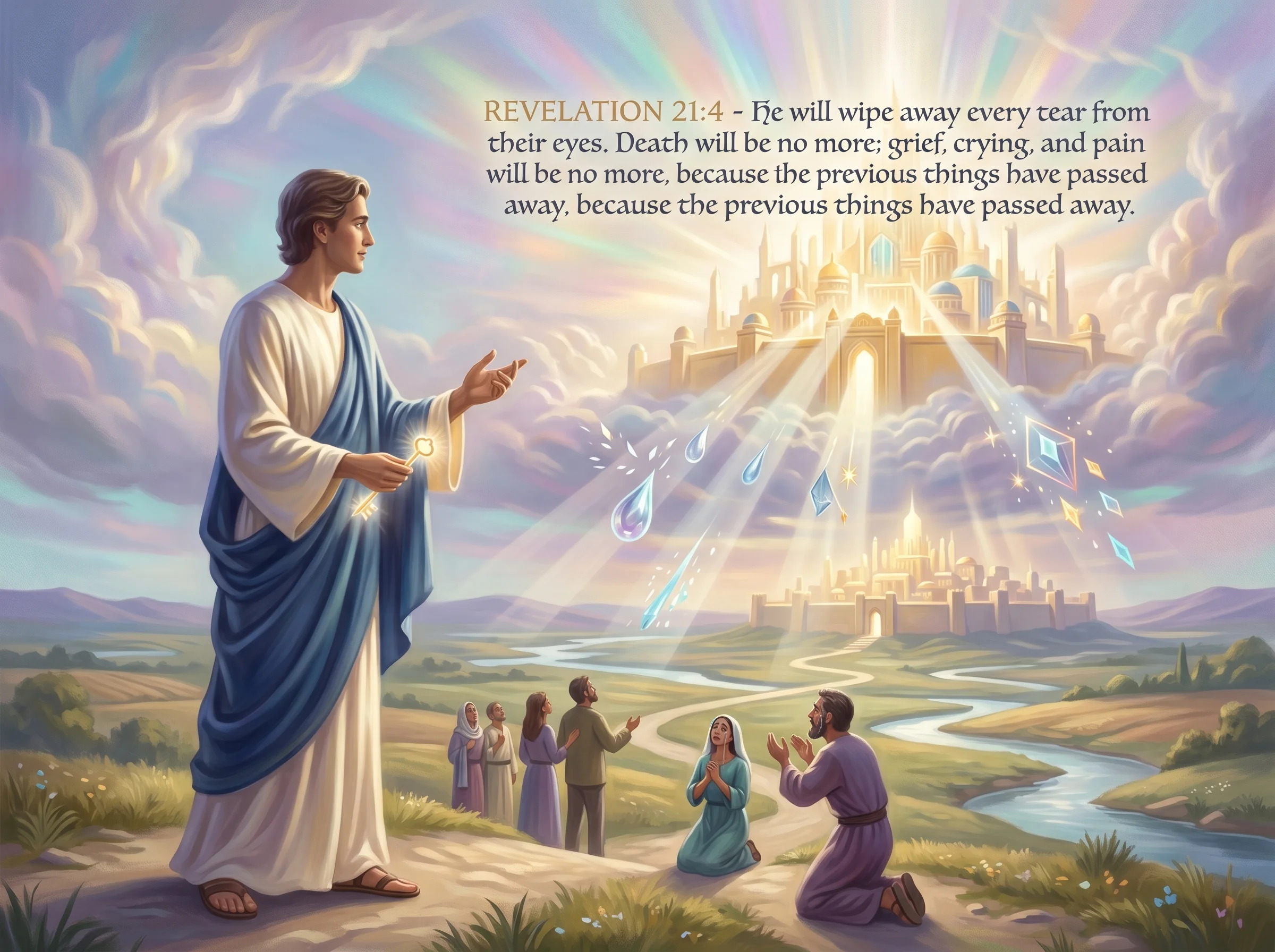
Revelation 21:4 — The End of Every Single Tear
📖 The Verse
"He will wipe away every tear from their eyes. Death will be no more; neither will there be mourning, nor crying, nor pain any more. The first things have passed away.” — Revelation 21:4 (WEBU)
In a world exhausted by grief, sickness, and endless bad news, God has scheduled an absolute expiration date for your pain.
To truly feel the weight of this promise, we have to look at the man holding the pen. The Apostle John was an old man when he wrote the book of Revelation, likely around AD 95. He was entirely isolated, exiled by the Roman Empire to a rocky, barren prison island called Patmos. He had outlived all the other apostles, and he had watched nearly all of his closest friends die horrific, violent deaths for the sake of the Gospel. The early Church was enduring the brutal reign of the Roman Emperor Domitian. Christians were being marginalized, stripped of their businesses, imprisoned, and executed because they refused to declare that Caesar was Lord. Believers were living in a constant state of anxiety, weeping over the loss of their spouses, their children, and their freedom. It was a time of immense, suffocating darkness for the followers of Jesus Christ. Revelation is a piece of apocalyptic literature, a specific literary style that uses vivid, dramatic, and highly symbolic imagery to reveal heavenly realities. Prophecy of this kind is meant to pull back the curtain on what God is doing behind the scenes. For an ancient believer reading this scroll by candlelight, these words were not just beautiful poetry; they were a lifeline. When John wrote these words, he wasn’t offering empty platitudes to a suffering church. He was delivering a direct, divine revelation that the crushing power of the Roman Empire—and the very existence of suffering itself—was temporary. John was reminding traumatized believers that the Lord Jesus Christ holds the final victory, and that a day was rapidly approaching when the Emperor’s sword would be broken and God Himself would bring all human suffering to a permanent halt.
🔍 Original Language Deep Dive
The Original Text: καὶ ἐξαλείψει πᾶν δάκρυον ἐκ τῶν ὀφθαλμῶν αὐτῶν, καὶ ὁ θάνατος οὐκ ἔσται ἔτι, οὔτε πένθος οὔτε κραυγὴ οὔτε πόνος οὐκ ἔσται ἔτι· ὅτι τὰ πρῶτα ἀπῆλθαν. (kai exaleipsei pan dakryon ek tōn ophthalmōn autōn, kai ho thanatos ouk estai eti, oute penthos oute kraugē oute ponos ouk estai eti; hoti ta prōta apēlthan.) In the original Greek, the phrasing is intensely final and deeply personal, emphasizing not just the removal of sorrow, but the total obliteration of everything that causes it. Key Word Breakdown:
- ἐξαλείψω (exaleipsō) — This verb means to completely wipe away, to wash over, or to entirely obliterate. In the ancient world, it was used to describe erasing ink from a parchment or wiping a wax writing tablet completely smooth. God is not merely drying our tears; He is completely erasing the record of our sorrows so that they can never be read again.
- δάκρυον (dakryon) — This is the word for a tear, specifically a single teardrop. The phrasing "every tear" emphasizes that God sees and addresses every specific, individual sorrow we have ever experienced. Your tears are not grouped into one generic pile; the Lord intimately knows the origin of every single drop.
- θάνατος (thanatos) — This translates directly to death, referring to both physical death and spiritual separation. It is the ultimate enemy of human existence, the cruel separator of families, and the ultimate curse of the Fall. Here, John declares that death will simply cease to exist; it will be permanently evicted from God's restored Creation.
- πένθος (penthos) — This word means mourning, grief, or sorrow. It specifically refers to the outward, visible manifestation of grief—the kind of weeping that happens at a graveside. God promises to eliminate the agonizing process of grieving the loss of those we deeply love.
- πόνος (ponos) — This describes intense labor, great pain, or severe physical and mental distress. It is the word used for the exhaustion of a diseased body or the heavy, crushing burden of carrying a painful load. All sickness, all physical decay, and all chronic pain are covered by this word, and all of it will be permanently eradicated.
🔥 Life-Giving Significance
This single verse captures the ultimate culmination of the grand, sweeping narrative of Scripture: Creation, Fall, Redemption, and Restoration. In the beginning, God designed Creation to be a place of perfect fellowship, entirely free from pain, disease, and death. When Adam and Eve rebelled in Genesis 3, sin fractured that perfect design. The Fall introduced the curse: the ground would produce thorns, childbirth would bring pain, bodies would decay, and humanity would ultimately return to the dust. From that dark moment onward, all of history has been a story of a broken world groaning under the weight of decay. But God, in His boundless mercy, did not abandon us to the curse. The Redemption phase of the story centers entirely on the Lord Jesus Christ. Jesus stepped into our brokenness, taking on human flesh. He physically wept at the tomb of Lazarus. He felt the sting of betrayal, the agony of the whip, and the torturous pain of the cross. By taking the full weight of our sin upon Himself, He broke the legal power of death. When Jesus Christ walked out of the tomb on Sunday morning, He secured the down payment of our eternal victory over the grave. Our salvation is fully guaranteed by His grace through faith in His finished work. Revelation 21:4 is the grand finale: Restoration. This is the moment the Second Coming of Jesus Christ achieves its ultimate, visible result in the physical universe. Pentecostal theology boldly celebrates that God is a healer today, and we experience genuine, miraculous touches of His Holy Spirit here and now. Yet, we recognize that every physical healing in this life is a temporary signpost pointing toward this ultimate, permanent reality. On that great day, God’s covenant promise will be finalized. The curse will be entirely lifted, and the righteousness of God will fully saturate a newly remade world, free from the stains of sin forever.
✨ Key Insights
- The Ultimate Intimacy of God: God does not delegate this task to an angel or a servant. He Himself intimately touches the faces of His children to wipe away their tears. The Sovereign Lord of all things is also a tender Father.
- The Absolute Expiration of Death: Death feels incredibly permanent to us right now, but from heaven's perspective, death has an expiration date. It is a defeated enemy that is simply waiting for its final sentence to be carried out.
- The Complete Dismantling of Sorrow: God systematically removes every layer of our suffering. He removes the inward agony (pain), the outward expression (crying), the process of loss (mourning), and the root cause (death).
- The Passing of the First Things: The current world system, which is driven by greed, decay, sickness, and violence, is referred to as "the first things." They are temporary. They are destined to pass away, making room for a permanent kingdom of light.
- God Validates Our Earthly Pain: By promising to wipe away our tears, God acknowledges that our earthly pain was real and difficult. He doesn’t tell us our tears were foolish; He simply promises they will be the last ones we ever cry.
- Pain is Not Eternal for the Believer: No matter how chronic an illness is, or how deep a psychological trauma runs, it is strictly bound to this temporary age. For the child of God, suffering has no place in eternity.
📚 Cross-Reference Treasury
- Isaiah 25:8 — "He has swallowed up death forever! The Lord Yahweh will wipe away tears from off all faces..." This profound Old Testament prophecy laid the foundation for John’s vision, proving that God’s plan to obliterate death has been His intention since the days of the prophets.
- 1 Corinthians 15:26 — "The last enemy that will be abolished is death." The Apostle Paul perfectly aligns with John's vision, confirming that while Jesus defeated death at the cross, its final, literal removal from human experience will be the closing act of God's redemptive plan.
- Romans 8:18 — "For I consider that the sufferings of this present time are not worthy to be compared with the glory which will be revealed toward us." Paul reminds us that the pain we experience in the "first things" will be completely eclipsed by the overwhelming joy of God's restoration.
- John 16:33 — "I have told you these things, that in me you may have peace. In the world you have oppression; but cheer up! I have overcome the world." Jesus is honest about the reality of our current suffering, yet He guarantees that His victory has already secured our ultimate future.
- Revelation 7:17 — "For the Lamb who is in the middle of the throne shepherds them and leads them to springs of waters of life. And God will wipe away every tear from their eyes." This beautifully connects Jesus, the Lamb of God, as the very source of life and comfort who makes this tearless eternity possible.
🌍 A Picture of This Truth
Imagine a devoted parent sitting in the dim, sterile light of a hospital room beside their young child. For months, the child has been battling a terrible, painful illness. The parent has spent countless sleepless nights listening to the steady beep of heart monitors, holding their child’s hand through agonizing treatments, and weeping quietly in the hallway. They have watched their beloved child cry out in pain, exhausted and diminished by a sickness that feels relentless. The weight of the hospital room feels like it will never lift. But then, early one morning, the leading doctor walks into the room with tears of joy in his own eyes. He holds up a final chart and says, "It’s gone. The disease is completely eradicated. It will never, ever come back." The parent walks over to the bed as the morning sunlight breaks through the window. The child wakes up, still frightened, still remembering the pain of the night before. The parent leans down, gently wipes the sweat and the dried tears from the child's exhausted face, and whispers, "It’s over, sweetheart. You’re healed. We are going home, and you will never have to step foot in this hospital room again." That moment of overwhelming relief, that tender touch of a parent declaring the end of a nightmare, is merely a shadow of the cosmic reality coming for the people of God. That's exactly what God is declaring over His children in Revelation 21:4. When we finally step into His presence, He will lean down, wipe our faces, and declare that the nightmare of sin and death is over. As Isaiah prophesied, "He has swallowed up death forever! The Lord Yahweh will wipe away tears from off all faces" (Isaiah 25:8, WEBU).
- Give yourself permission to grieve with hope. If you have lost a loved one, mourning is a natural, healthy response to the unnatural reality of death. Cry those tears, but let them be tears anchored in the hope that a reunion is coming. Death does not have the final word over those who sleep in Christ.
- Reframe your chronic pain or illness. If you are battling a sickness or carrying physical pain that doctors cannot cure, remind yourself daily that your condition is temporary. Continue to pray in faith for divine healing today, but rest in the ironclad guarantee that you will have a glorified, flawless body in eternity.
- Limit your intake of 2026's anxiety-inducing news. It is incredibly easy to believe the world is spinning out of control when our screens constantly broadcast violence, decay, and corruption. Counteract the heavy news cycle by meditating on the fact that God has already written the final chapter. The "first things" are passing away.
- Bring comfort to others right now. As believers filled with the Holy Spirit, we are called to be the hands and feet of Jesus. Look for someone in your church, your workplace, or your family who is mourning or struggling, and sit with them. Be a tangible expression of God's future comfort in their present darkness.
- Check your spiritual citizenship. Are you investing all your time, money, and emotional energy into a world system that God says is passing away? Shift your focus. Invest your life in the things that will survive into eternity: the Word of God and the souls of men and women.
🙏 Reflection & Prayer
Reflect on this: When was the last time you allowed the reality of heaven to genuinely comfort you in a moment of deep earthly pain? What would it look like if you stopped viewing your current struggles as permanent, and started viewing them as temporary trials that are already marked with an expiration date by the blood of Jesus? A Prayer for Today:
Lord Jesus, I am so incredibly grateful that You hold the future in Your hands. Some days, the grief, the sickness, and the heavy burdens of this broken world feel entirely overwhelming to me. But I praise You because You conquered the grave, and You have promised that pain will not be my permanent address. Holy Spirit, please comfort my heart today when the tears come, and remind me of the glorious future You are preparing for me. I lay my anxieties, my fears of death, and my current sorrows at Your feet. Give me the strength to live today with the unshakable joy of knowing that, very soon, You will wipe every tear from my eyes. In Your beautiful and victorious name I pray, Amen.
💬 Share this deep dive with someone who needs it today — and come back tomorrow for the next Verse of the Day!